Thursday, June 23, 2011

Nov 14, 2010, Swallow Cliff, from Chicago Area Orienteering Club (CAOC)

This was my second time to do an orienteering course on this map.  As far as I knew, this was the only orienteering map in Chicago area that had steep hills.  Chicago is a flat land, so having steep hills in this place is quite special.

When I came here first time, I did a green course and turned out to be the first place finish.  Now I came back and did a red course, and I did not do badly, either.  I got the shortest time of all the red courses that I had done.  My current goal was to finish a red course within 1 hour 30 minutes, and this was the first time I achieved it.

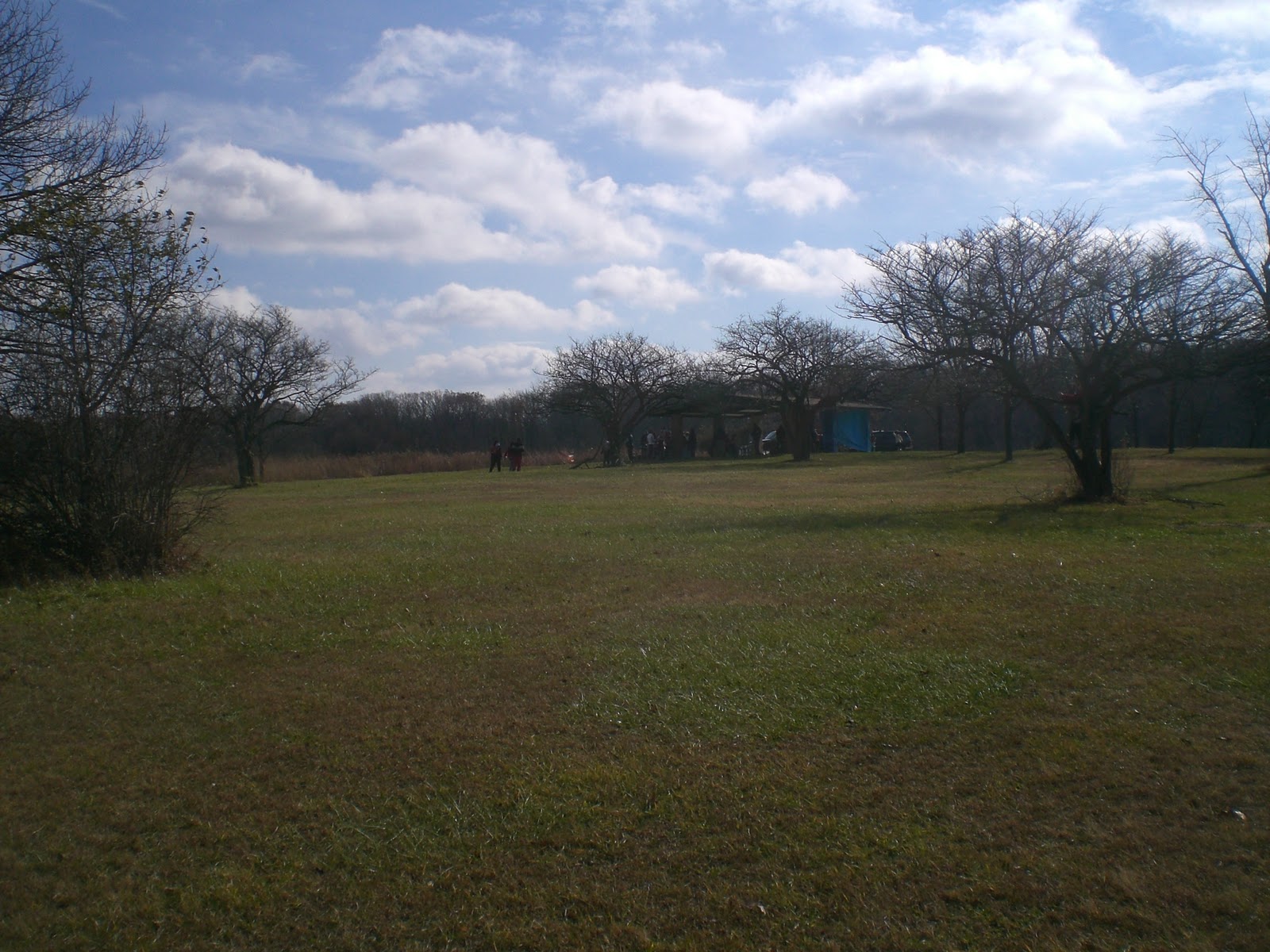
I arrived late and the parking at the start/finish point (Cherry Hill Woods) was full.  Unfortunately, I had to drive 1 km north to park at Teason’s Wood and followed the markers to walk back south.  Therefore, I got some warm-up before I started the course.


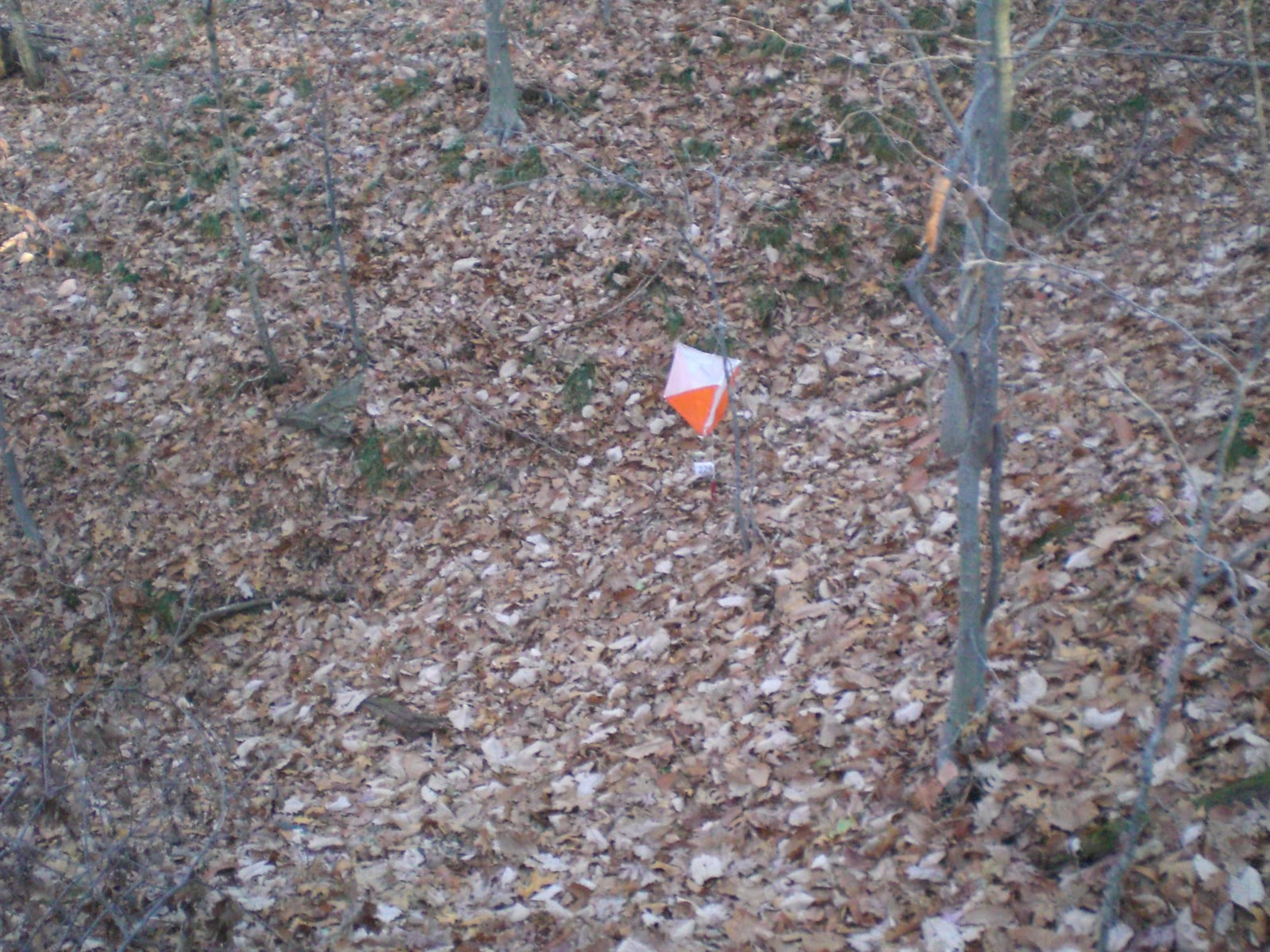
Finally, I arrived at the event center.

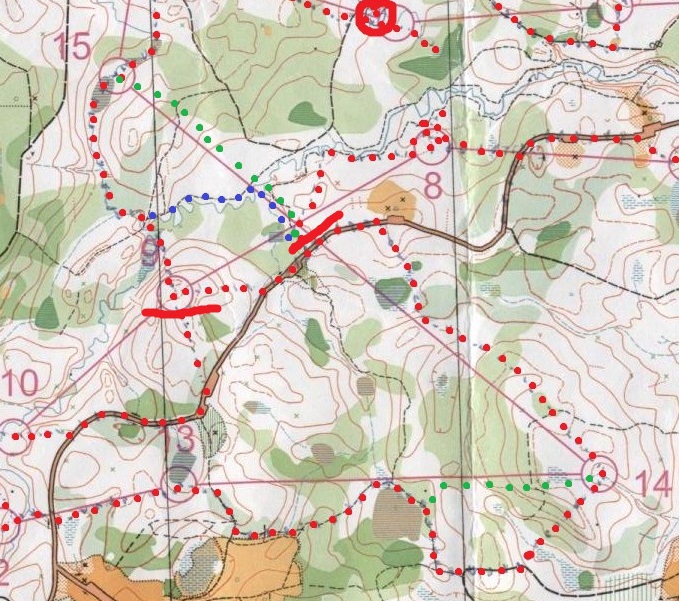
After I got the map, I felt that I had time to find some geocaches nearby before starting the course.  I had many caches to find in the nearby area, so I thought I should find a few before starting the orienteering course.  Seeing that the approximate locations of the geocaches would not spoil the course, and I had some time before the start closed, I finally found 3 caches near the start points.

Red crosses indicate the location of the geocaches

After finishing the orienteering course, I found some other caches.  However, they were outside of this map so I would not mention here.

Now get back to the main course: the red orienteering course.  The map, my route, and my split times were shown below.


I wondered what made me do well in this place for two times.  My guess was that this map is relatively easy to navigate, since there were many handrails on the map (e.g. paths, streams).  The re-entrants were also mostly clear.

I would separate the course into several sections and pick several controls to talk about in order to keep the blog short.

Control start-5: There is nothing much to say about the first 5 control points.  At the beginning open land, some burning had happened that made the area look black (see picture below).  I travelled through the forest to find the lake. After meeting the main path, I used the indistinct stream as a path to get to the open area.  The next few points had clear paths to lead me to or close to the controls.   I made a mistake in control 4 and identified the wrong re-entrant.  The purpose of control 5 and 13 was to force us to use the underpass, since the road above is a major roadway.


Control 5-7:   Control 6 and 7 were also easy.  The re-entrant to control 6 was clear.  In control 7, I used the major trails most of the time to get to the control.  I just needed to be careful in counting the bends on the trail.  Perhaps an alternative route was to go more south to the road and use the road to lead to control 7, but you had to go downhill and then uphill.  Running through the forest seemed not to be a good idea because the forest was not easy running and there was a re-entrant to climb.

Control 7-10:  I felt the most challenging decision was control 7-8.  I was not sure if there were any better routes.  I used to road and then the major trail north of control 8.  Then, I needed to know where to bend south from the road to the control.  It appeared to me that using other trails to get to control 8 was too dangerous.  In fact, I felt that this section was one of the more challenging sections of the course.  I was also not sure how to professionals would run from control 9-10.

Control 10-13:  The river might get my feet wet in this section of legs, but the navigation by re-entrant, river, and paths was not a problem.  I also wondered: are there any better routes than my choice?

Control 13-finish: This was another section of the legs that I could consider challenging.  It was at the end of the race.  From control 13-14, one had the climb the hill.  Then, the rest of the controls were quite short and in a re-entrant system.  The section seemed to test my concentration when I started to feel tired.  In control 14-15, I tried to run as straight as possible (i.e. not following the path), but avoided the drops at the re-entrants.  In control 15-16, I had to get across the main re-entrant.  In control 16-17, I used to path to get close to control 17.

Therefore, Perhaps I could finish to course under 1 hour 30 minutes because the course was relative easy.

When I came back, I met Rich Gaylord again.  He gave me an orienteering map in Danville, IL (about 30 minutes drive east of where I am) that he ran in 1970s.  It was nice to see how the map changed after many years.  Therefore, I had a reason to continue to run orienteering courses in Chicago, since I had to return the map to Rich.

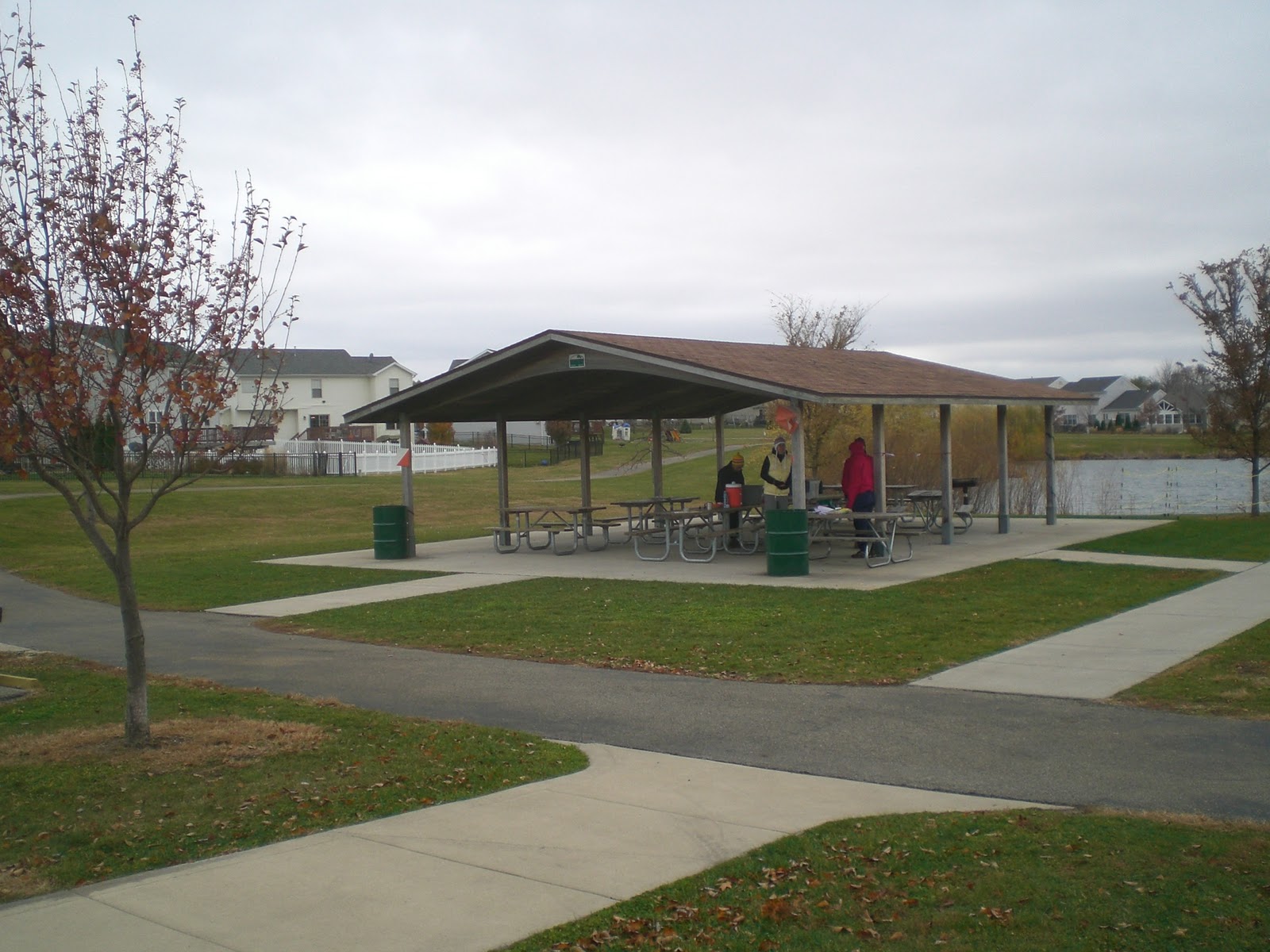
Nov 13, 2010, A sprint – Northtrail Park, from Illinois River Valley Orienteering Club (IRVOC)

The event

Probably I attended this event because I loved orienteering so much.  The drive was almost two hours, but a sprint orienteering course can be finished within 15 minutes, so attending this event was uneconomical.  Moreover, I had another regular orienteering event to attend in the following day in Chicago.  The major reason for attending this event was actually because I had not done a sprint course before, so I would like to give a try.


The map of the course is shown below.  Note that this was a new map and was used for the first time.  The course was also very easy and had a yellow rating, so this course was about who made the decision fastest and ran fastest.


Moreover, I took a panoramic video to show how close the controls were next to each other.


The entire course took me about 11 minutes to complete.

Nov 6, 2010, Yellowwood State Forest, from Indiana Crossroads Orienteering (ICO)

1.       The event

I remembered that I had high expectation on this event. This place is about 40 miles south of Indianapolis, IN and near Bloomington, IN.  The area is hilly, which is very different than the generally flat terrain in Chicago area.  Still, the forest is generally easy running (i.e. white forest in the orienteering map).  Moreover, a blue course is expected to be seen in this event.  In the US, a blue course is the advanced course with the longest length (i.e. > 8 km).  I am willing to enjoy running in the hilly forest for longer time.

Therefore, I attended this event.  It was a day that was well below freezing.

Map showing the location of Yellowwood State Forest.  It is close to Bloomington, IN, where Indiana University is located.


I took a lot of pictures in this event.  Therefore, I would rather put more pictures than words in this entry.

Event Center:


Beginner clinic – for those who are doing orienteering for their first time


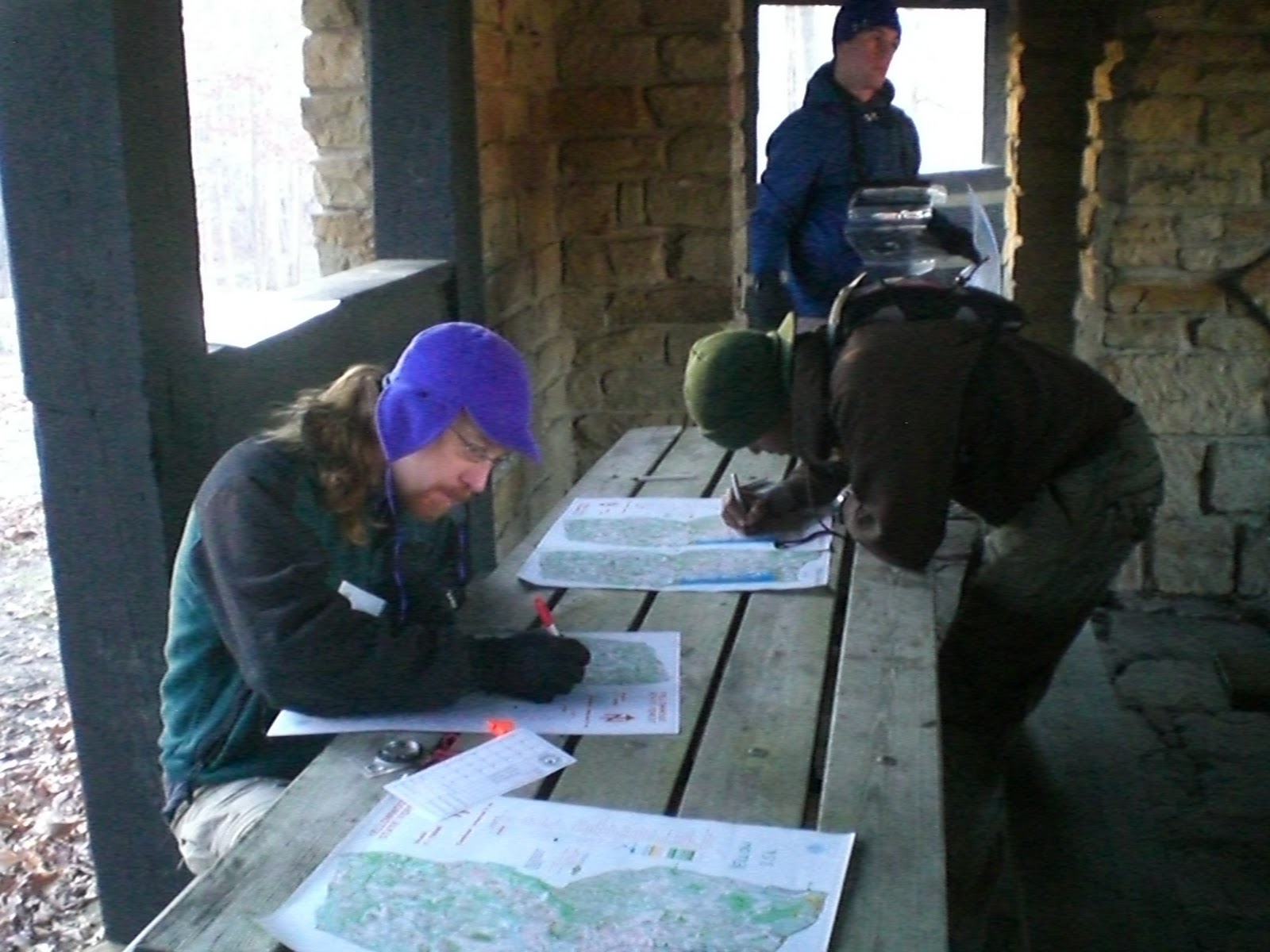
 In ICO events, we usually have to copy the course from a mother map


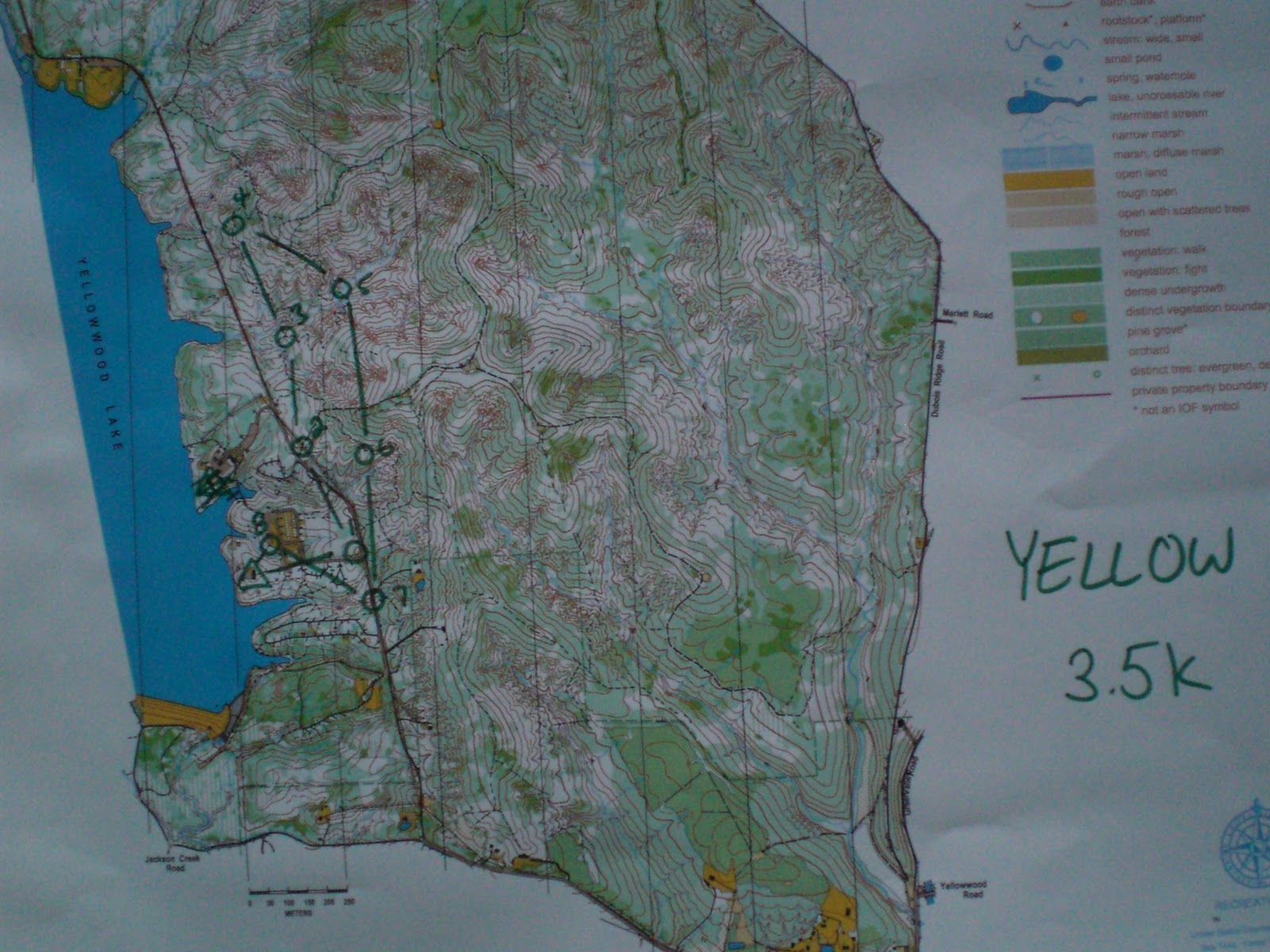
I took some pictures of the other courses.  For the beginners, try reading the White and Yellow course and think about how you would tackle it.

White – the easiest


Yellow – for the advanced beginner


Orange – for the intermediate orienteers


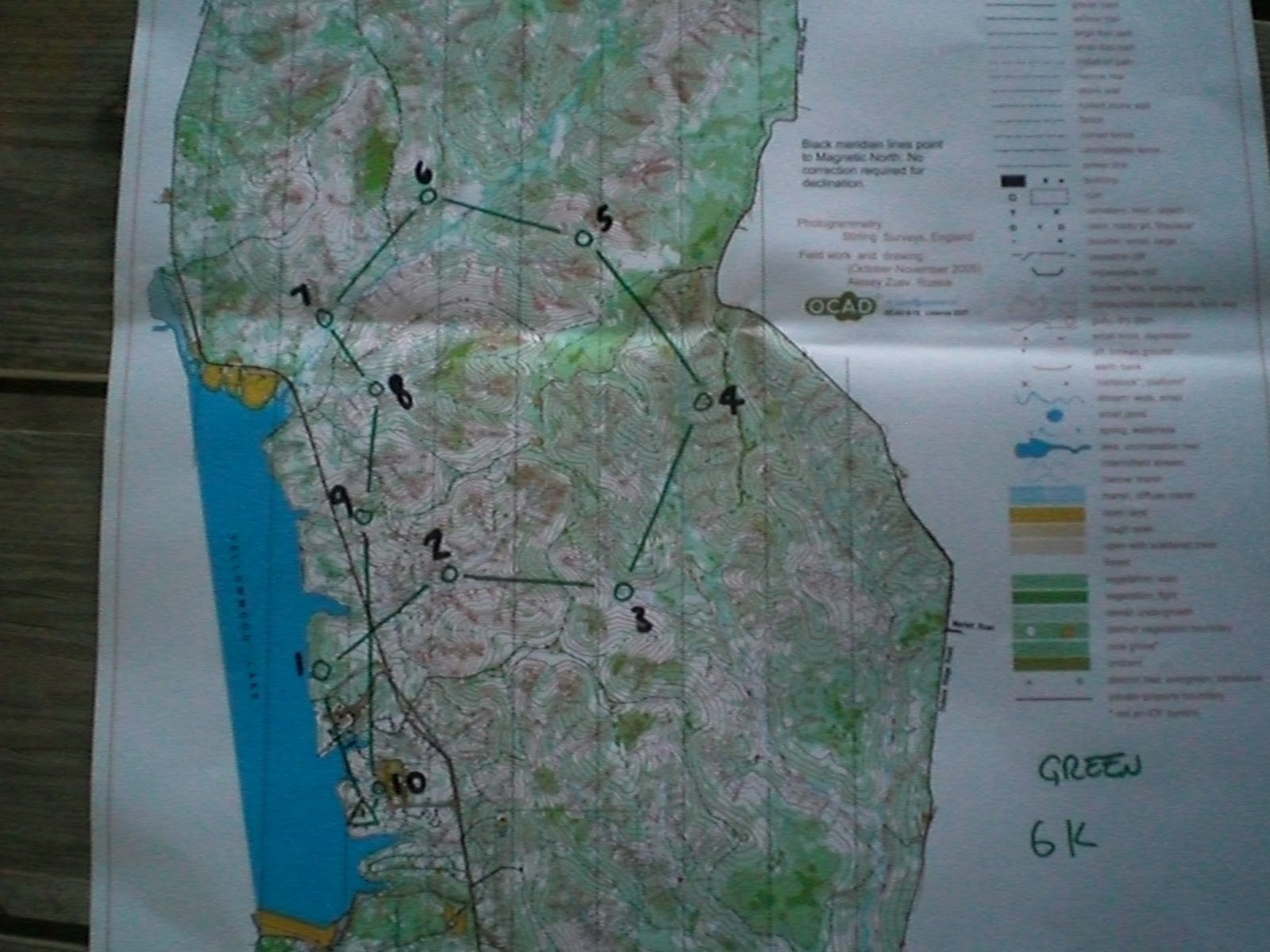
Green – advanced, shorter (6 km is a reasonable green course)


Note that the map is huge.  The map had a size of almost four A4 papers. Last year, a 6 hour/12 hour rogaine has been organized in this area.

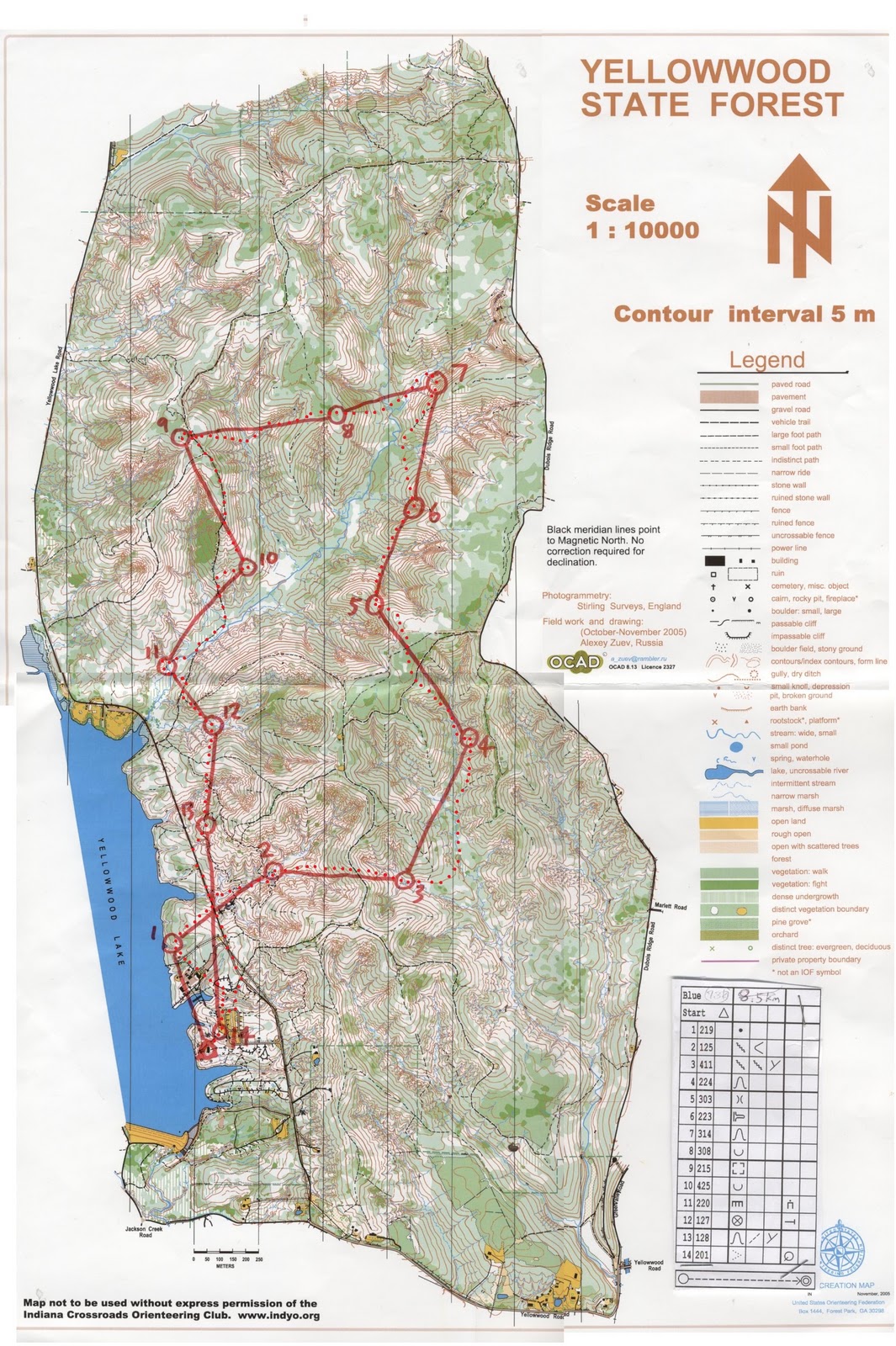
Now, the featured blue course that claimed to be 8.5 km long (and my route):


This course was the same as the green course, but controls 6-9 were added.  After drawing the map, I somehow felt that the course was shorter than 8.5 km…

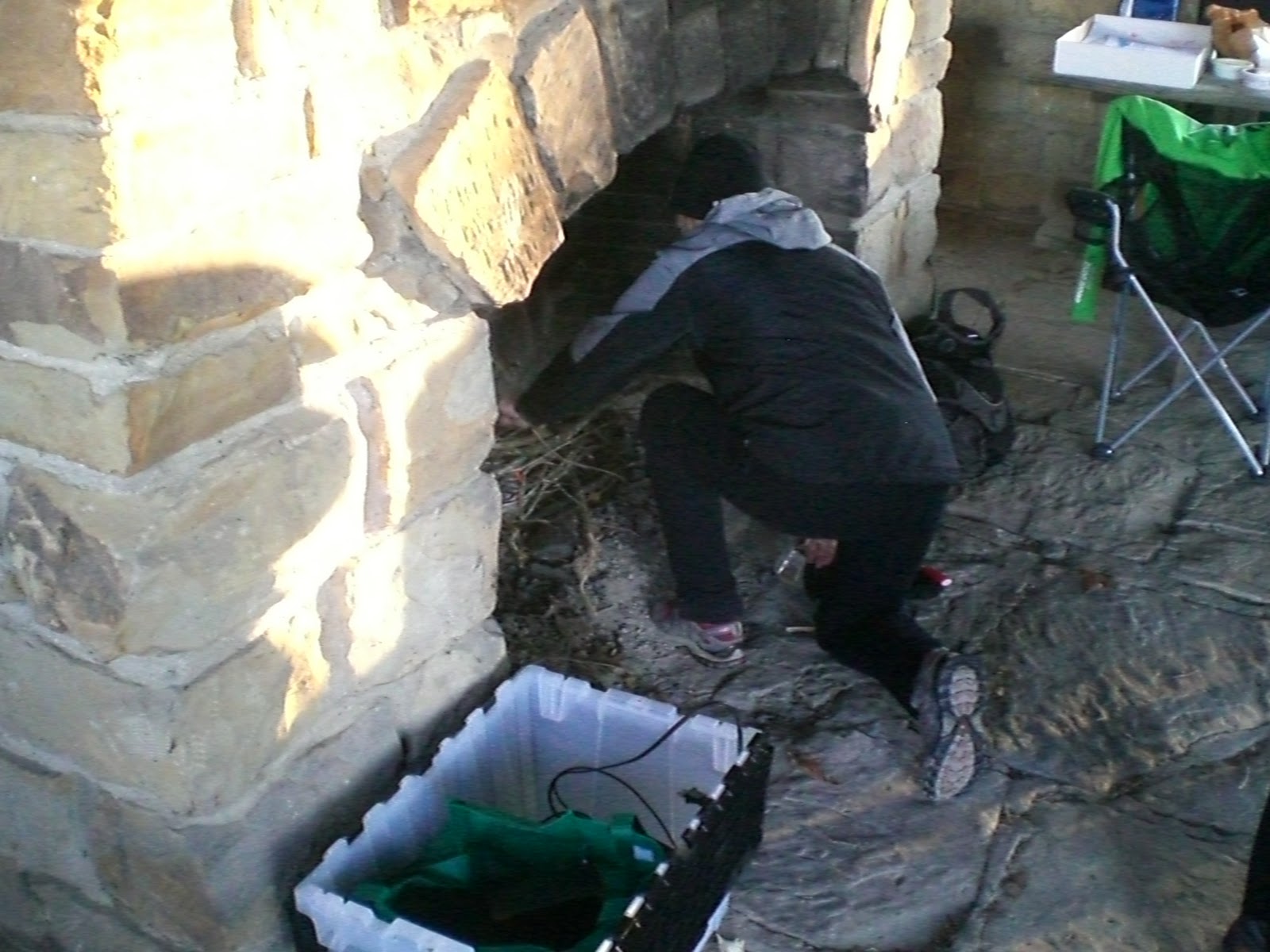
As we drew the map, someone helped to start a fire.  Warm…


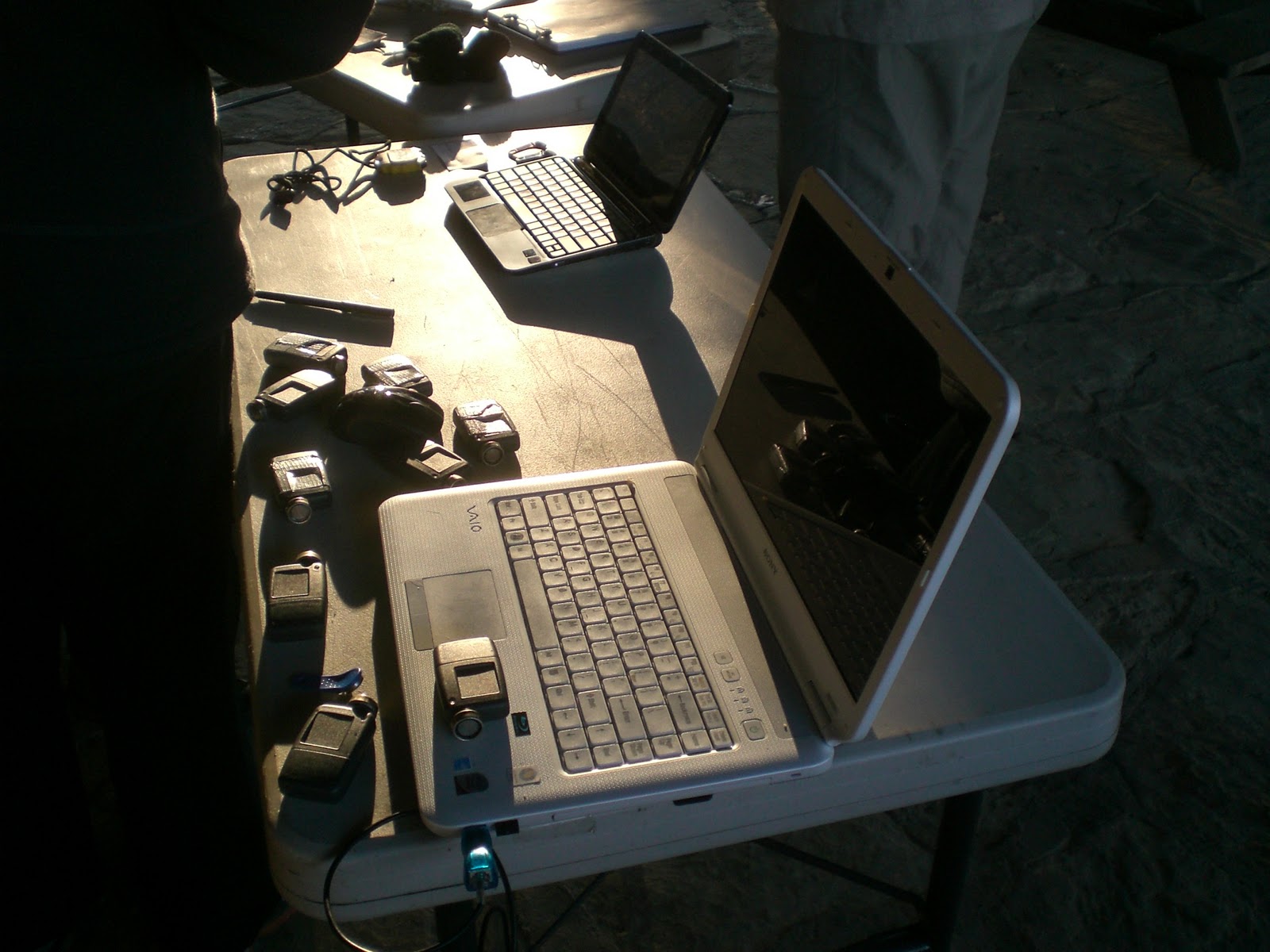
This is the first time to see ICO to test a e-punch system.  The orienteering events by ICO usually used traditional punches to verify visits of controls.  ICO only had a few of these e-punch system, so I arrived the event center early to ensure I could test the system.  It turned out that this e-punch was the largest I had ever seen.


Computer system


Start and finish punch


So I had finished drawing the course on the map and I could start at any time!


The location of the control 1 looked like the picture below


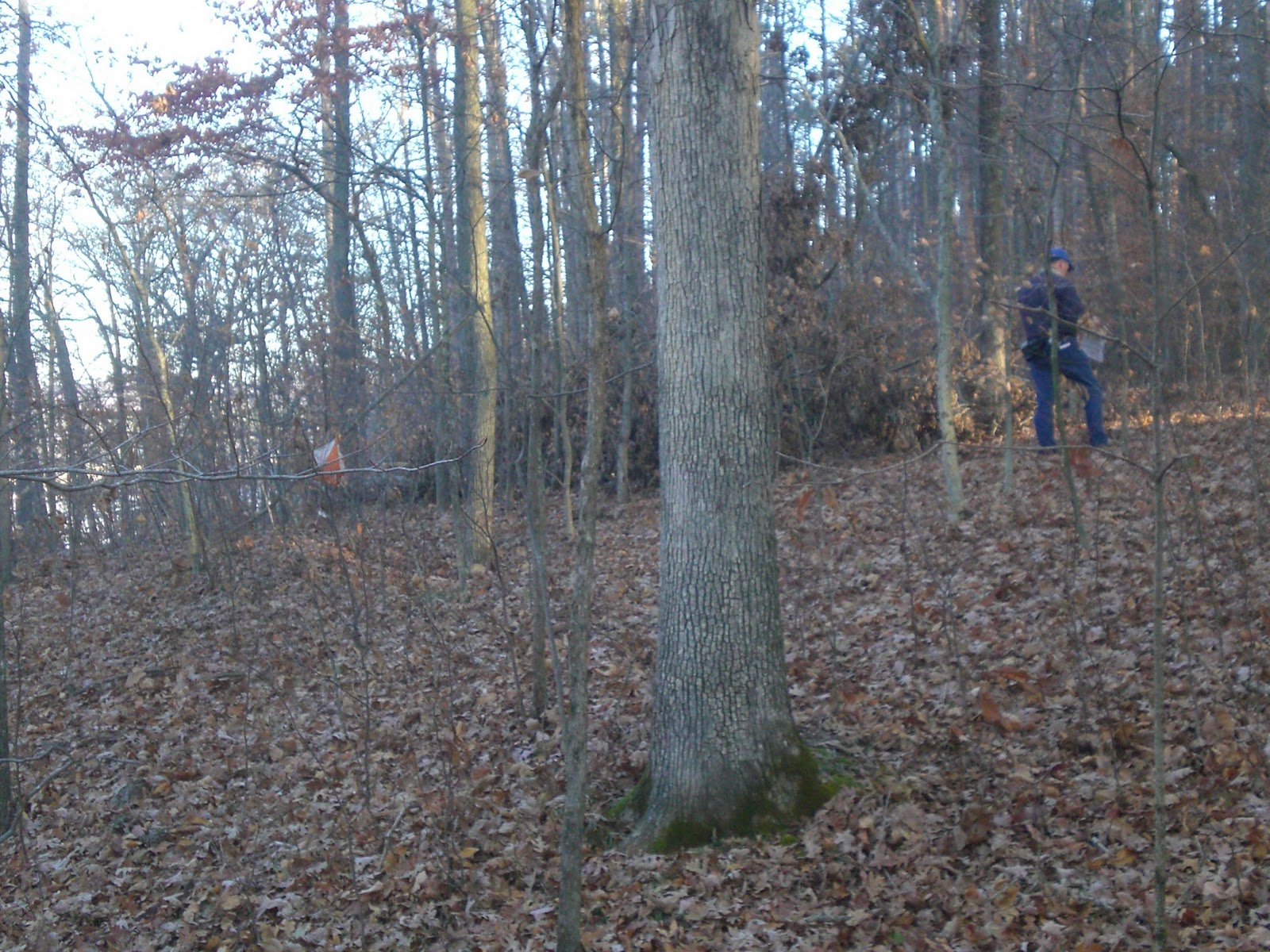
A picture on how the control looks like.  There was a metal piece attached to the traditional punch, which is for the e-punch purpose.


On my way to the second control.


And the control.


On control 3, I had to go uphill.  I did not see any better route other than going up and then going down.  Control 3 looked like this.


I followed the stream to guide me to the control 4.  Now I could think how I could be sure which re-entrant contained control 4.


I also needed to go uphill in control 5.  Once I got to the other side of the hill, the ridge became easy to find.

Control 6 posed a classical question: should I take shorter route but have a lot of hill climbing, or a longer route but with much less hill climbing?  (see the picture below) This was a question that I was not able to answer in the past.  Like this one, I did take the shorter but more strenuous route.  When I compared my result with the others who took the longer route, the longer route is faster.


Here is a picture of control 6.


By that time I did not know how strenuous is to gain a contour line (i.e. going uphill).  Now I felt that I should not go uphill and then downhill for control 7.

A picture of control 7.


Control 8 was another one that going uphill was unavoidable.  I tried to take a picture that showed the steepness of the hill:


And the control 8:


Since then, I did not take any more pictures along the course, since I almost lost my camera after control 8.  I found out that my camera disappeared, so I backtracked to see if I could find the camera.  The effort was not successful.  Then another orienteering person passed through the control 8 and said he found a camera nearby, and that was indeed my camera.  I felt so lucky that I got my camera back.

Control 9 was actually another tradeoff question that was similar to control 6.  Someone took a much longer route to northwest and followed the route back to southwest (see picture below).  I did not ask for his time on this control, so I could not have any comparison.  Nevertheless, now I think such route choice could be a valid one.


Somehow I felt that I did not have much to say for the rest of the controls.  They looked easy to navigate using the shortest route.  I felt kind of anti-climatic after finding these controls.

I did take a picture when I ran along the road from control 13 to 14.


One more thing was that I was excited to see the new e-punch system before the event.  However, along the course, many metal pieces at the punches were missing, so I could not use the e-punch in many controls.

Therefore, my high expectation became some disappointment because 1) the course was actually not 8.5 km long.  I went home and used a ruler to measure the course length, and it was about 7.5 km.  This explained why I felt I only ran a orienteering course like a red course in Chicago.  2)  Controls in the later part of the course can be more challenging.  3) I could not enjoy the use of the new e-punch system because many punches were missing (I hope they will keep improving the e-punch system, though).  The cold weather, however, did not affect my mood in doing orienteering.

2.      Geocaching

Before leaving, I searched 4 geocaches near the start/finish line.  The locations of these geocaches are marked on the map below.  Supposedly, one may do geocaching without a map, since GPS is the only essential tool.  A map, however, helped me to travel around the wood faster.  Marking the locations of these geocaches also encourages me to be aware of my location all the time, so that I can mark them at the right location.


One of the caches was almost next to the start/finish line.  I also took some pictures of some caches.  These caches were just typical finds.

Tuesday, February 1, 2011

Oct 31, 2010, Deer Grove, from Chicago Area Orienteering Club (CAOC)

1.      The event

Let’s see if I could shorten the report so that I can catch up with the following orienteering reports.  This orienteering course was done after 2 full days of West Coast Swing (WCS) dancing.  Let me attach a short video to show how the professional did a routine of WCS.  If I have time, I would write a short report about that 2 days of WCS workshops.


Deer Grove is in the northern Chicago area (Palatine, if someone is familiar with Chicago area).  A picture was taken at the start/finish point.  That day was Halloween, so you can see a pumpkin in the picture.


The red course also had many controls this time.  This time I divided the course into the following 4 parts:

a)      Control 1-6: short legs
b)      Control 7-13: medium legs A
c)      Control 14,15: long legs
d)     Control 16-finish: medium legs B


There were nothing much to comment in the short leg section.  It seemed that these controls helped me to warm up.  I could use compass bearing to visit each of the controls.

There were some comments on the medium legs A.  Some of the legs are route choices.  Would there be a better route so that I can run faster?  Moreover, would the route be unsafe? Examples of unsafe routes include lack of features for navigation. Some route is also harder to navigate, so looking at map fewer times and concentrating on running a longer route may be quicker than a shorter route with complicated navigation.

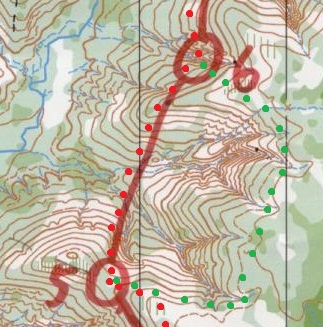
6à7: Which route should I choose?  I wonder if the following alternative route would be faster and still be safe (see the green dots):


7à8: I had some difficulty in finding this control, but I did not know any better ways to tackle this leg.

9à10: Perhaps running along the river is faster without sacrificing safety? (see the green dots)


10à11: Weird thing happened in this leg.  This leg should be easy, but I thought I visited the wrong point.  I saw 95 at the first time.  Feeling that I visited the wrong control, I left that place and searched the other area.  However, I did not see any other controls.  Given that leg 10à11 is so short, I felt that control number 95 was the correct control.  Therefore, I went back to control number 95 and suddenly realized what was going on: the control number was actually 56.  I read the number upside-down.

Let’s move on to long legs.  What alternative route choices do I have for control 14 and 15?


13à14: I think I should run on the trail in the first half of this leg.  In the second half, should I leave the trail early to take a shorter route (see green dots)?  It looks like I only need to run over a ridge and find a re-entrant to locate the control.  The height of the climb is not much – ~10m (note that the contour lines are 3m apart).  Therefore, I think that running on this shorter route may save some time.

14à15: I think I just need to get back to the road on the first half and use the road to re-orient myself, so a rough running direction would be enough.  In the second half, I think I should avoid the hill and use the trail instead to reach the stream. Then I can either go to the west side of the hill and follow another stream (blue dots), or to the right side of the hill that is shorter but has nothing else for navigation (green dots).  Personally I prefer green-dotted route because the hill can roughly help me to re-orient myself.  The control is not far away from the hill.

Finally, on the medium legs B, I only have one comment on leg 16à17.  The rest of the course was mostly trail or fence following.

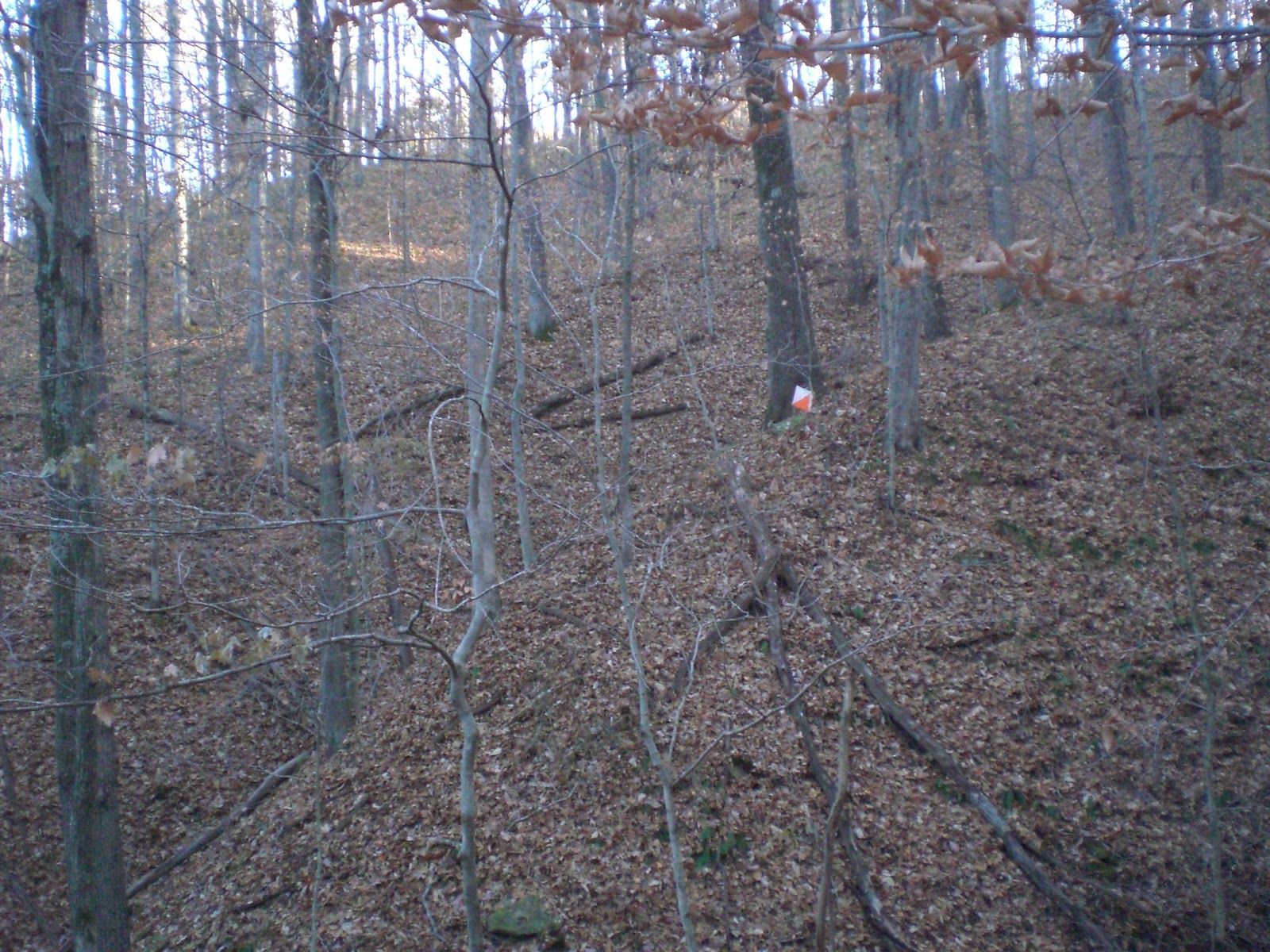
16à17: I did not take many pictures during this course.  This picture was the only one that I took.  See the green arrow on the map below the photo for the photo taking direction.


Then, I believed that control 17 was misplaced.  The map showed the control was at the stream bend that points south, but the actual control location was before this bend (i.e. west of the bend).  I did not follow the stream and went for the bend directly, only finding that there was no control.  I went farther away and then felt that I went too far, so I backtracked along the stream and found the control.

2.      Geocaching

Many caches were found when I drove along the road to Chicago.  Here I will just mention two caches that I found within the orienteering map.  The approximate locations of the caches were marked with orange crosses.


Both caches were close to the start/finish point in the map.  Both caches were regular caches, but the one on the island was supposedly much more difficult to reach.  A 5 out of 5 difficulty was shown for this cache.

  Some previous finder commented that the island was actually not an island.  There was a marsh that connects the island and the rim of the lake so that one does not need to get wet to reach the cache.  I found this marsh (see green dots on the map above) that took me to the island.

The next part was supposedly a lot of breaking of bushes.  Perhaps there was already some people went for this challenge.  Some indistinct trails were within the island so that walking through the bushes was less difficult than I thought.  The hide of the cache was also not too difficult.  Therefore, this cache with 5 out of 5 difficulty was not as difficult as I thought.

Oct 24, 2010, Willow Springs, from Chicago Area Orienteering Club (CAOC)

1.      The event

After 3 weeks of orienteering break, I came back to Chicago again for another orienteering event.  I was in the southwest of Chicago this time.  Looking back, I have done several orienteering events around this area, although each time I was in different part of the forest.  The map below shows the entire forest with orienteering map boundaries defined.


I arrived at the start point early, so I decided to find a few geocaches before the main orienteering event.  There are some interesting geocaches around this area, so I will talk about this later.

When I got ready to start and glanced at the clue sheet, I saw 21 controls.  I was happy to see that because this was the most number of controls I had even seen (except score-O events, where 40 to 50 controls are not uncommon).


Because of the number of controls, I am not going to describe each control.  Instead, this course was divided into several distinct sections.  I will name these sections as follows:

a.)    The long way north (control 1-5)
b.)    The long way south (control 6-9)
c.)    Southeast short legs (control 10-18)
d.)   The long way back (control 19-finish)

Part a.  The long way north

I was satisfied with what I had done in the first 5 controls.  Perhaps they were relatively easy to reach because simple handrails (i.e. distinguishable linear features such as trails and streams) were available in these 5 controls in most of the segments of the legs.  For example, from start to control 1 was a long way, but I could run mostly on trail and then I ran next to the stream when I got close and was west of control 1.  Control 2 to 3 was also mostly on trails.  I could use the roads for control 3 to 5 for the most parts of the legs.

Although I had tried learning to use the compass to walk to the control when no easily identifiable features are available, I felt that I started getting used to the compass with this course.  The technique that I learned to walk/run using compass is called Silva 1-2-3.  The general principle is that first I copy my intended moving direction on my compass from the map, then I can move to the correct direction with the needle of the compass alone.  The catch was just that I needed to practice several times so that I could perform these procedures correctly and quickly.  For example, when I ran north on the road from control 3 to 4, I copied the direction from the end of the road to control 4.  Then when I got to the end of the road, I could run confidently into the forest using the adjusted compass without looking at the map.

Part b.  The long way south

I think many of my errors occurred in this section.  Moreover, I almost DNF (do not finish) because of a fundamental error.  I will describe each control in this section here:

5à6:  this leg was short and I planned to use compass alone to lead myself to control 6.  However, I forgot to copy the bearing from the map, so I ran in a slightly wrong directly at the beginning.  Fortunately, I realized this later on, so I did not think I lost too much time on this leg.

6à7:  this leg was challenging because the leg did not have obvious handrails to use in straight line, and the leg was not short enough to rely on compass bearing only.  Since it is difficult to walk perfectly in one direction when inside a forest, the deviation from the true location can be large if I walk by following the compass alone for a long distance.  Therefore, this leg took me some time to think.  I finally used the southwest branch of the stream to guide me to a place close to control 7.  I did not realize the following at that time, but I saw control 4 by luck when I found my way to control 7.  Control 4 was close to control 7, and I saw a re-entrant that could help me to get close to control 7.  From there, I could start using compass bearing to get to the control.  I felt a little bit lost in this leg, but eventually managed to find the control.

7à8:  I lost a lot of time on this leg for two reasons. 1) From control 7 to the road south of the control, there is a lot of undergrowth, or specifically, thorns.  Now when I look back, I think I may move faster if I run southwest to the N-S road.  Then I may use the E-W road to reach the stream, which is the second half of the leg that I actually ran.  Alternatively, I may also use the major trail to run to a place very close to control 8 (the tiny peak shown by form line may be a great place to go off-trail).  Then, I can avoid a lot of overgrowth.  2) Then, when I climb above some fallen trees somewhere on the stream, I accidentally threw away the e-punch. I swung my arm to keep my balance and then I felt my finger had something missing.  This is the fundamental error.  Without the e-punch, I had nothing to record my status of visiting controls and I would be disqualified.  I also had to pay for the e-punch because I rented it.  Therefore, I stopped and searched for the e-punch.  Fortunately, I found the e-punch after ~5-10 min of search.  You know, I was in the middle of the woods.  The e-punch could be anywhere.

8 à 9: this leg was uneventful

Part c. Southeast short legs

There was nothing much to write about these legs (control 10 to 18).  These controls were not too hard to find.  I think I can do better on some of the legs (e.g. 11à12, 16à17).  I did not hit the right spot when I went to control 12, and I hesitated my running to control 17.  Perhaps if I ran close to the re-entrants from control 11, I could identify the location of control 12 more accurately.

Part d. The long way back

The last few legs were not as hard.  In 18à19, I used the trail for most of the part and I almost got the fastest time.  I could also use most of the trails in the 19à20 leg.  For the control 20à21, I avoided the green area (forest that slows you down) and then used the stream to lead me to the control.

2.      Geocaching

There were some interesting geocaches near the start/finish line.  The locations of the “caches” were marked with orange crosses.

On the left was a regular geocache that was in the woods. 

In the center, the two crosses marked the same series of caches that we called them a multi cache.  In this one, I had to visit the first location and found a locked ammo box marked with another GPS coordinates.  Then, I went to this location and found four letters.  I had to figure out that these four letters were the password for the lock in the first cache, unlocked it, and claimed the find of the cache.

On the right, there was a mystery multi cache.  Before I went here, I had to solve a puzzle that involves Scrabble to find the first GPS coordinates.  At the first coordinates, I found more Scrabble tiles to solve another puzzle and find the final cache location.