Thursday, June 16, 2016

May 7-8, 2016 Ontario Orienteering Championship (short summary: a lot of fun, but not good runs)

(I started to write this a week after this orienteering event, but other matters made this unfinished. After a month, I just wanted to finish this without giving too much thoughts...)

Prologue

One day, Jan from Czech Republic said hi to me, asking if I am interested in the Ontario Orienteering Championship in early May. Jan once helped me a lot in maintaining the new university orienteering club in the University of Illinois, but he left two years ago after his exchange ended. Before we parted, we went to Florida for a fun trip and did an orienteering there. We learned that in Florida, off-trail choices could be scary, since we met numerous snakes. Jan even met an alligator before.

Now, he stayed in Toronto, asking me if I could visit him. Yes. The drive was long (10 hours one-way), but from my spying of Ontario maps, I would enjoy navigating through this area. He even told me that Canadian dollars were very cheap now. Thus, I participated this orienteering championship and the road trip.

(Side note: he showed me a Toronto park map that he set the course with and asked me opinions on route choices. The map looks nice as a city park!)

On May 6 (Fri), I rented a car for this long road trip, stayed at a friend's place in Michigan for a night, crossed the Canadian border the next day, and arrived at University of Waterloo area.

Middle Distance

One and a half hour before the first orienteering event, I felt very hungry in the car. Thus, I went to the rest area for a burger meal. It filled up my stomach, but I made a big mistake for not drinking enough water.

When I got to the race venue, my start was within 30 minutes. While I managed to carry basic items for orienteering (plus the GoPro camera), I did not realize the need of water before the race. Before starting, I was excited to see a new map. When I actually got started and saw the map, I was still happy that I went to the right place to challenge my orienteering skills:


The map has a lot of contours to play with. The small map makes this a great middle-distance orienteering location, where the test of navigation skills is the focus.

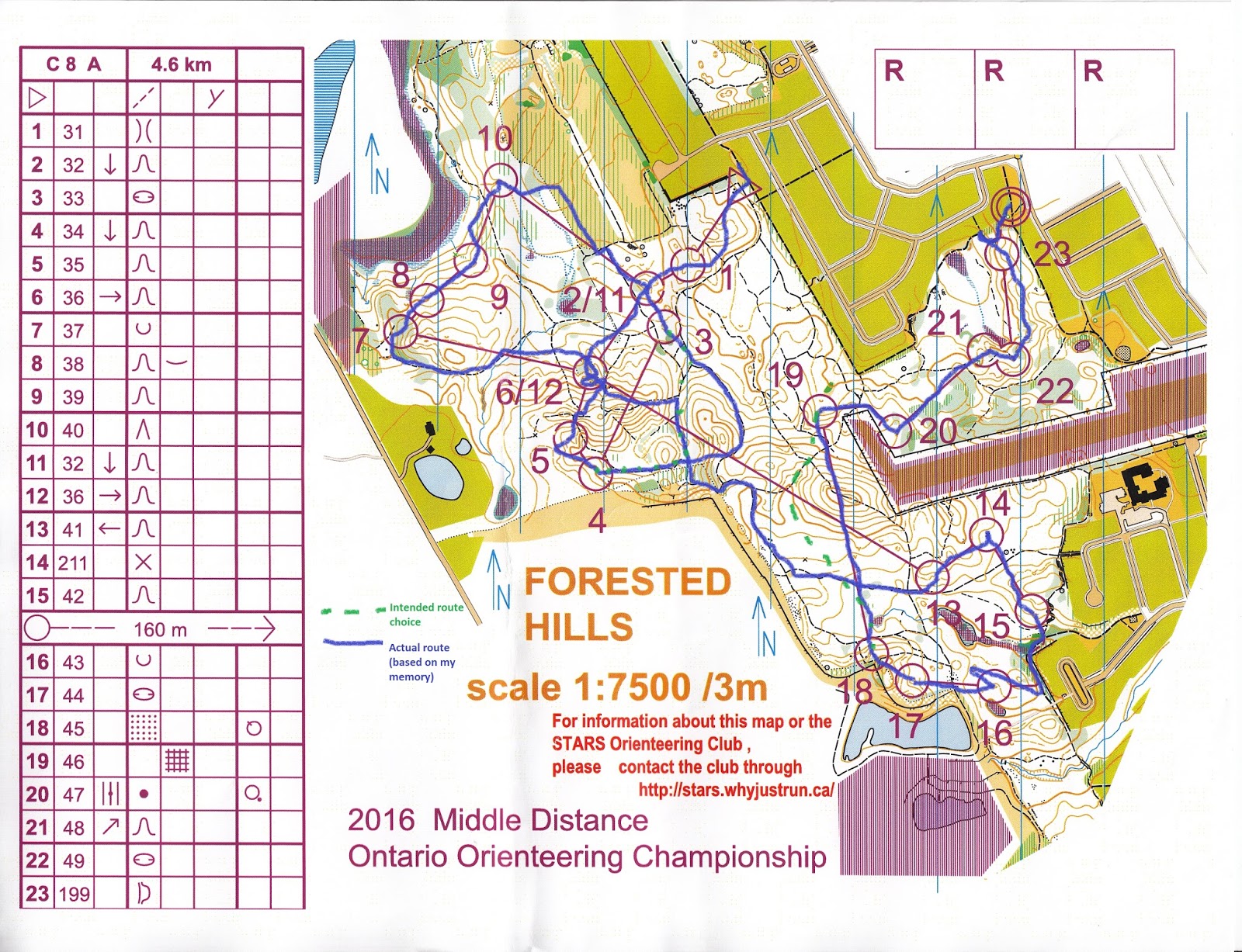
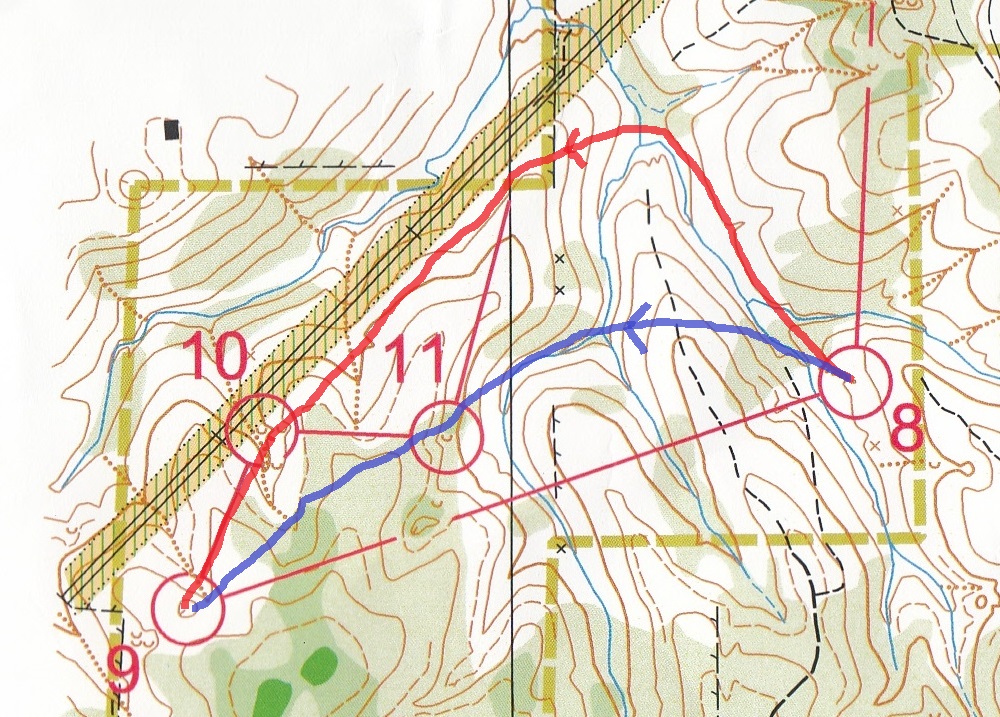
Unfortunately, I felt the roughness of navigation at the beginning. To #1, I could not navigate at the correct angle, and needed the trail to reorient my direction. To #4, I made the wrong trail choice. To #5, my angle of attack deviated again. To #6, I walked back and forth to find the right gully (re-entrant).

After finding #6, my mouth started to get very dry. I started to feel that I just wanted to survive in the course, and started walking. Then, controls were not too difficult to find, but I lost the competitiveness.

Still, I overshot at #16, climbed to the highest point when going to #19 (I thought of using the ridge to reduce the climb), and to the finish, I was attracted to the wrong control next to the apartments.

Finally, I finished.

Photo by Sid (the photo taker of this Championship)

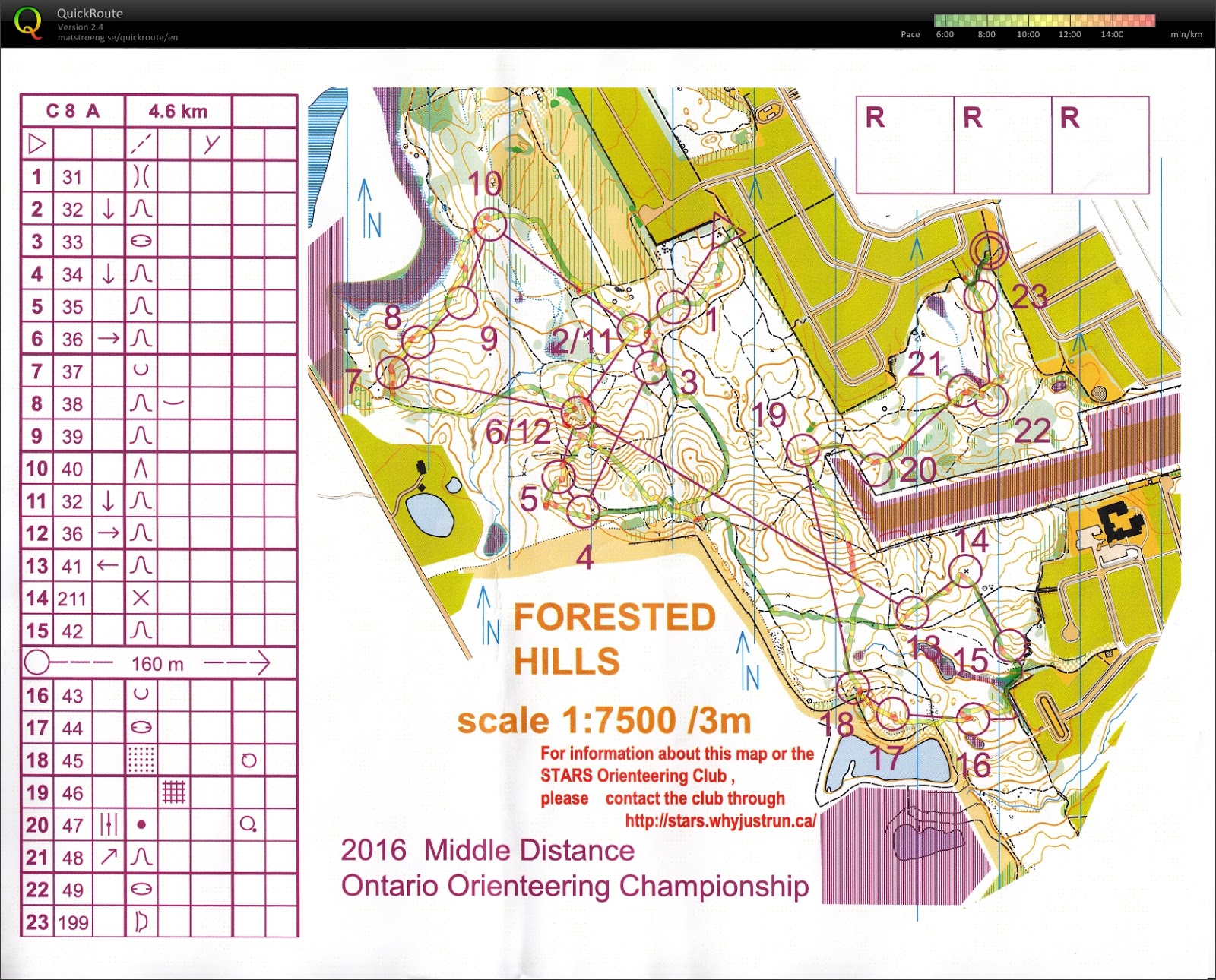
To show that I did not totally rely on my GPS watch to recall my route, I drew on the blank map first. Then, I overlaid the GPS data on the map:


Here is the GPS data. I think I forgot how I went from 12 to 13, thus I made such mistake on my hand-drawn route.


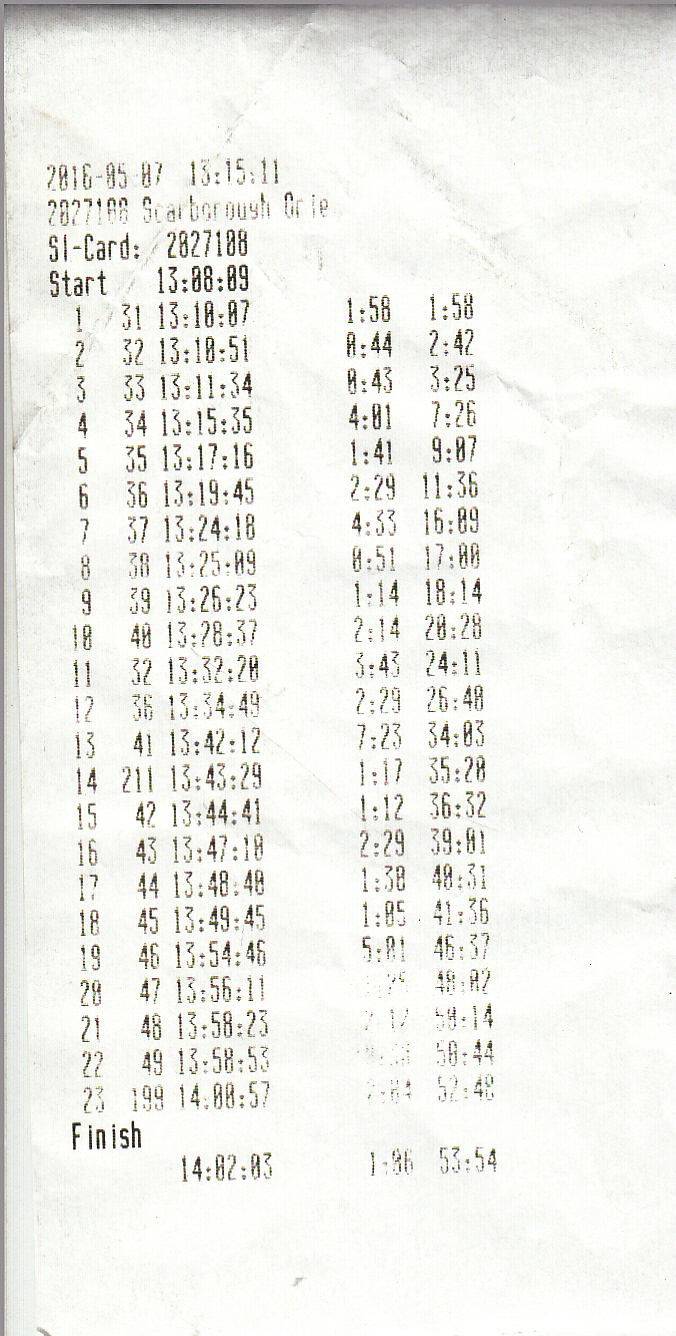
The result was not worth mentioning...


Below is the video:


Sprint

The sprint was about two hours after the middle distance. The sprint occurred at University of Waterloo, which was <10 min drive from the middle distance course. I had been here before, but it was > 8 years ago.

I was the first to start. Still, I had some time to prepare because there was a 20-min delay in start times. Before starting, I took a picture with Jan.


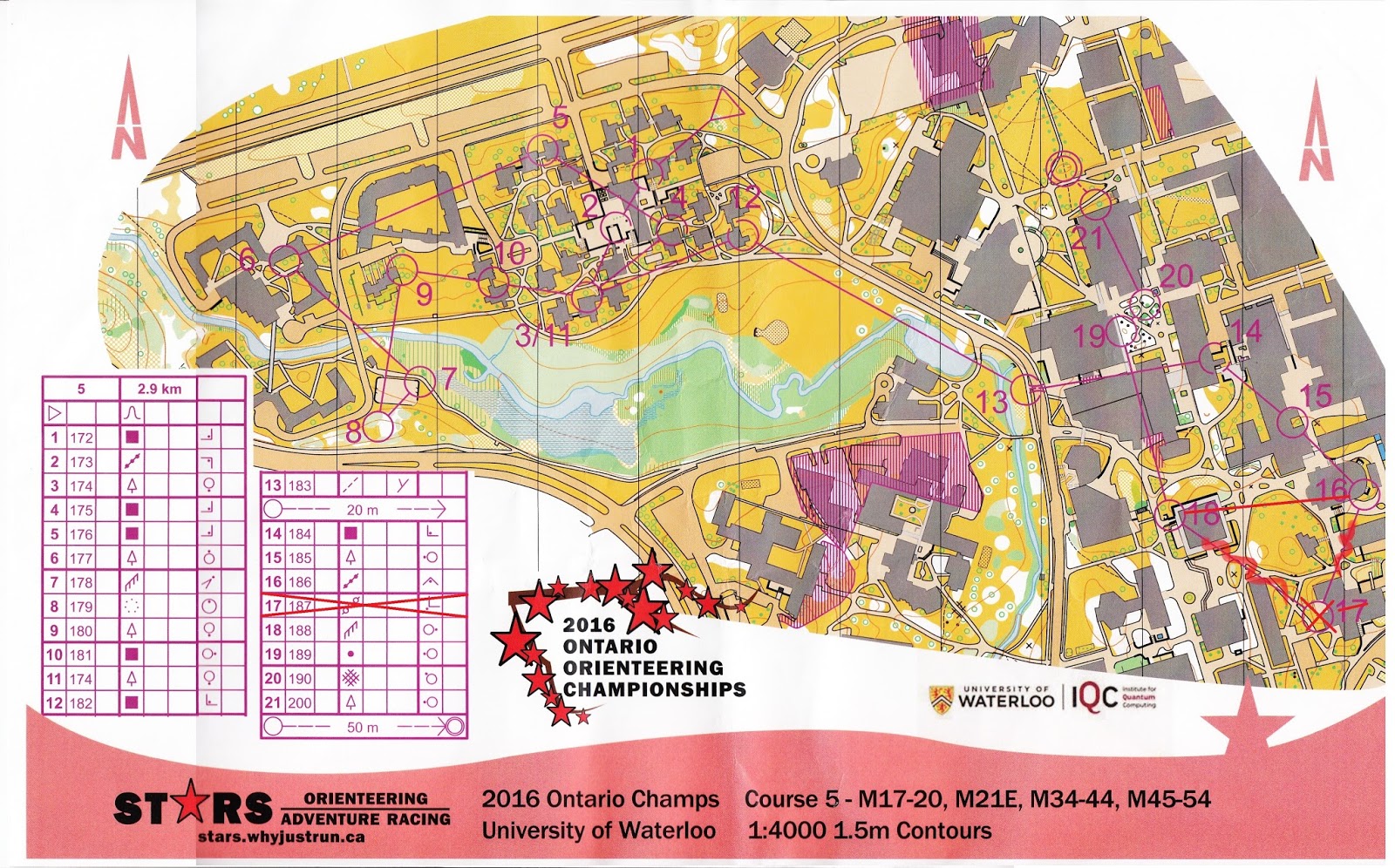
This time, I was well hydrated, and I could run as fast as possible. When I got started, I found a troublesome leg for Control #1-#2:


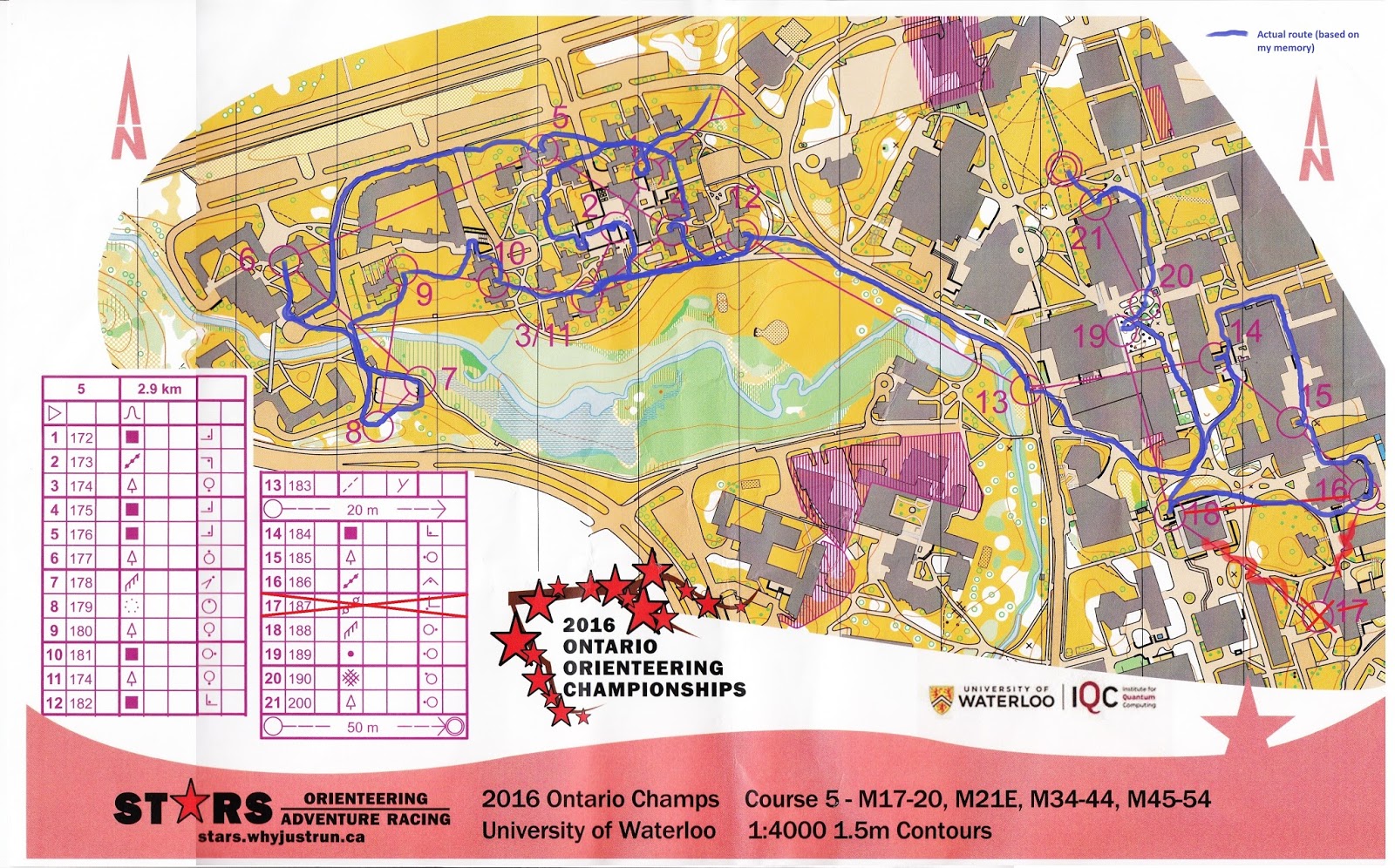
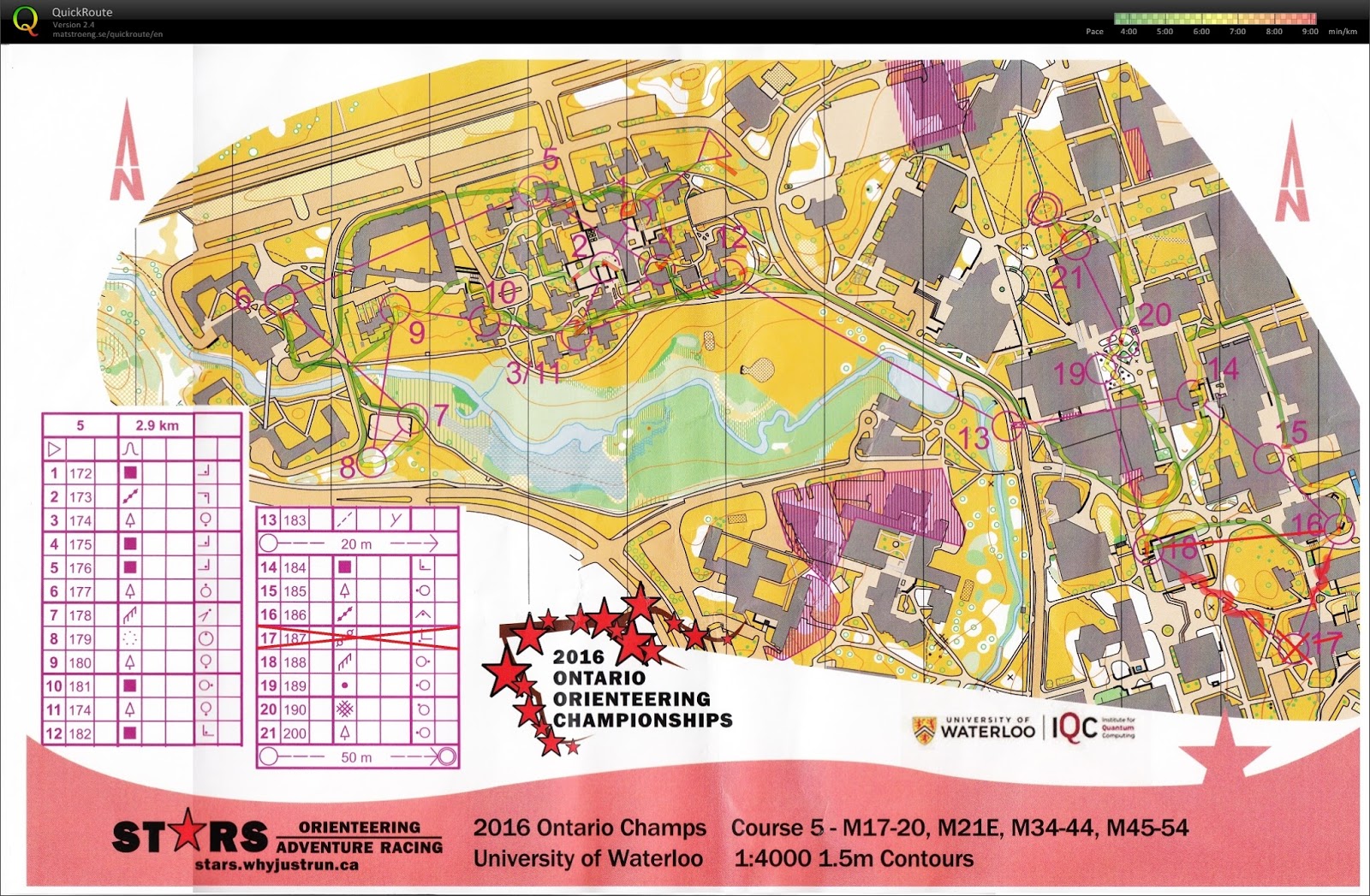
This is probably the hardest leg of the race. Finding the shortest route to #2 took time. I overshot when going from #3-#4. I thought even if I overshot one block, at least the second block should have an entrance to pass through. However, the second block was not passable. I think there is a mapping error there.

After #4, things went smoother. I could find the best routes without much of the problem. There were still detours from point to point, but the choices are just either go right or left.

I did find this sprint was fun.

Here is my hand drawn route:


...and here is my GPS record. I think they virtually match exactly.


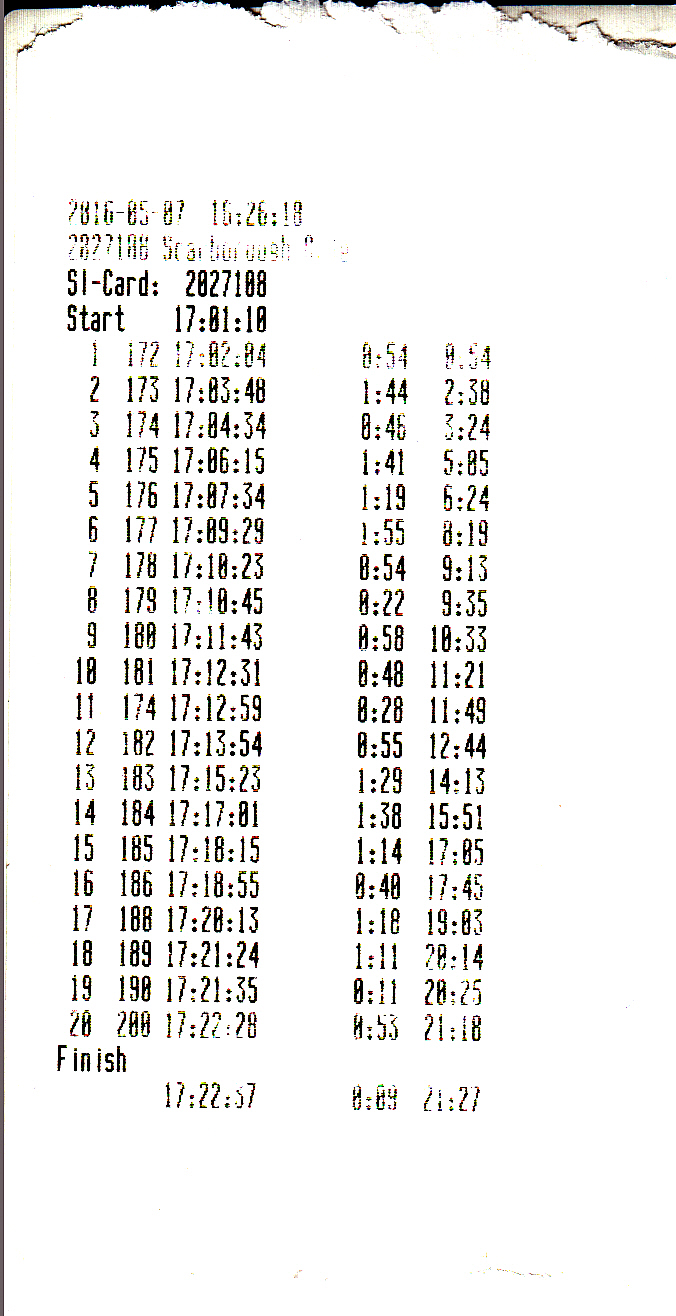
The fastest person finished in 16 minutes, though.


Here is the video on the sprint:


After the sprint, Jan guided me to his home in Toronto. He showed me an area that I had never been. We got some good food, and I could stay at his place for a night.

Long

Seeing that I could handle 10 km course last time in Cincinnati, I decided to take the M21 course, which is ~11 km long. The map, Mono Cliff, is at ~1 hour north of Toronto. I had an impression that maps in Canada are fun (read: complicated) to navigate. I hope I should at least enjoy the map.

At the start, we once again took a picture together. This time, the start was delayed for >40 minutes because course vetters came back late.


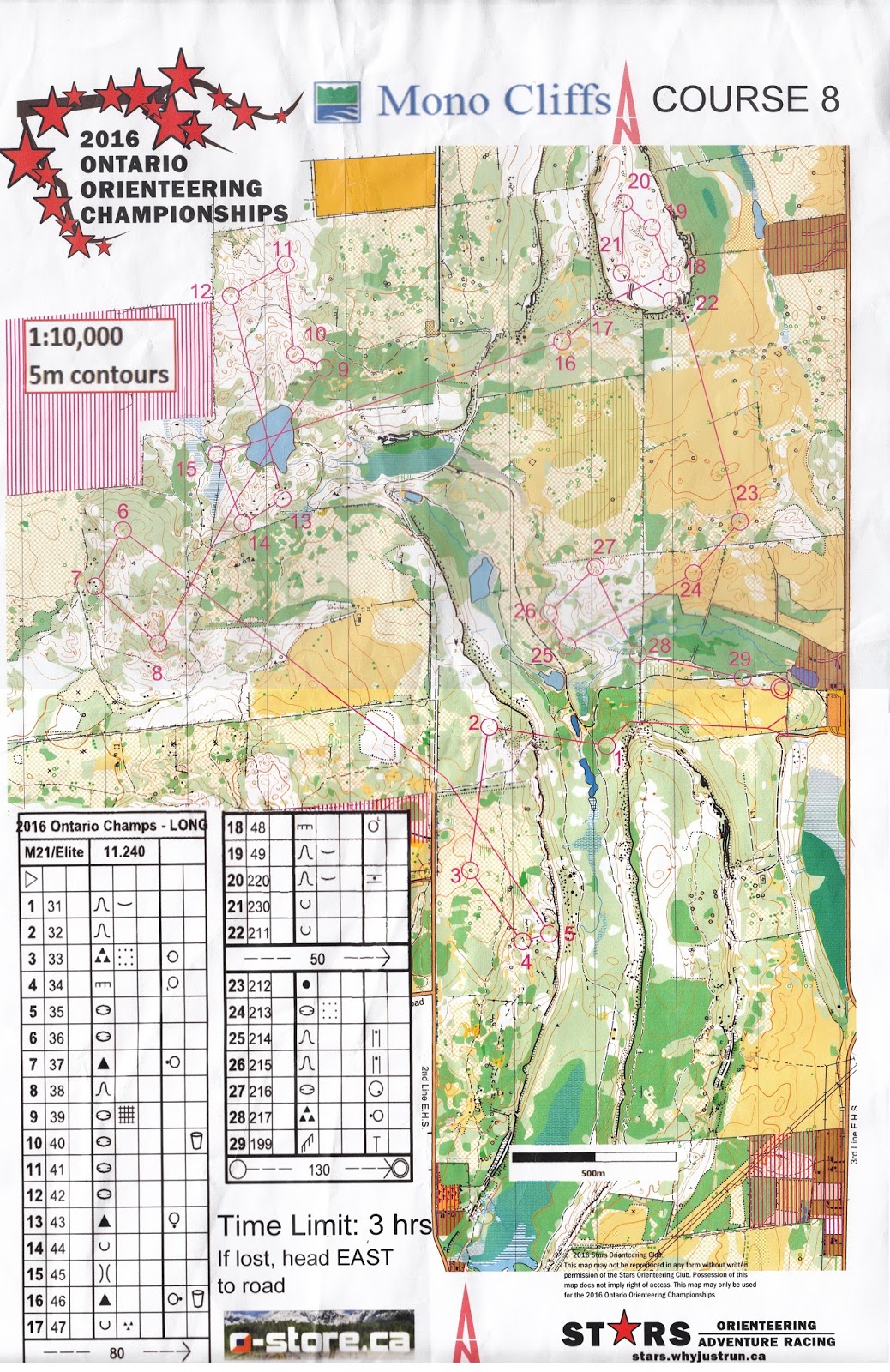
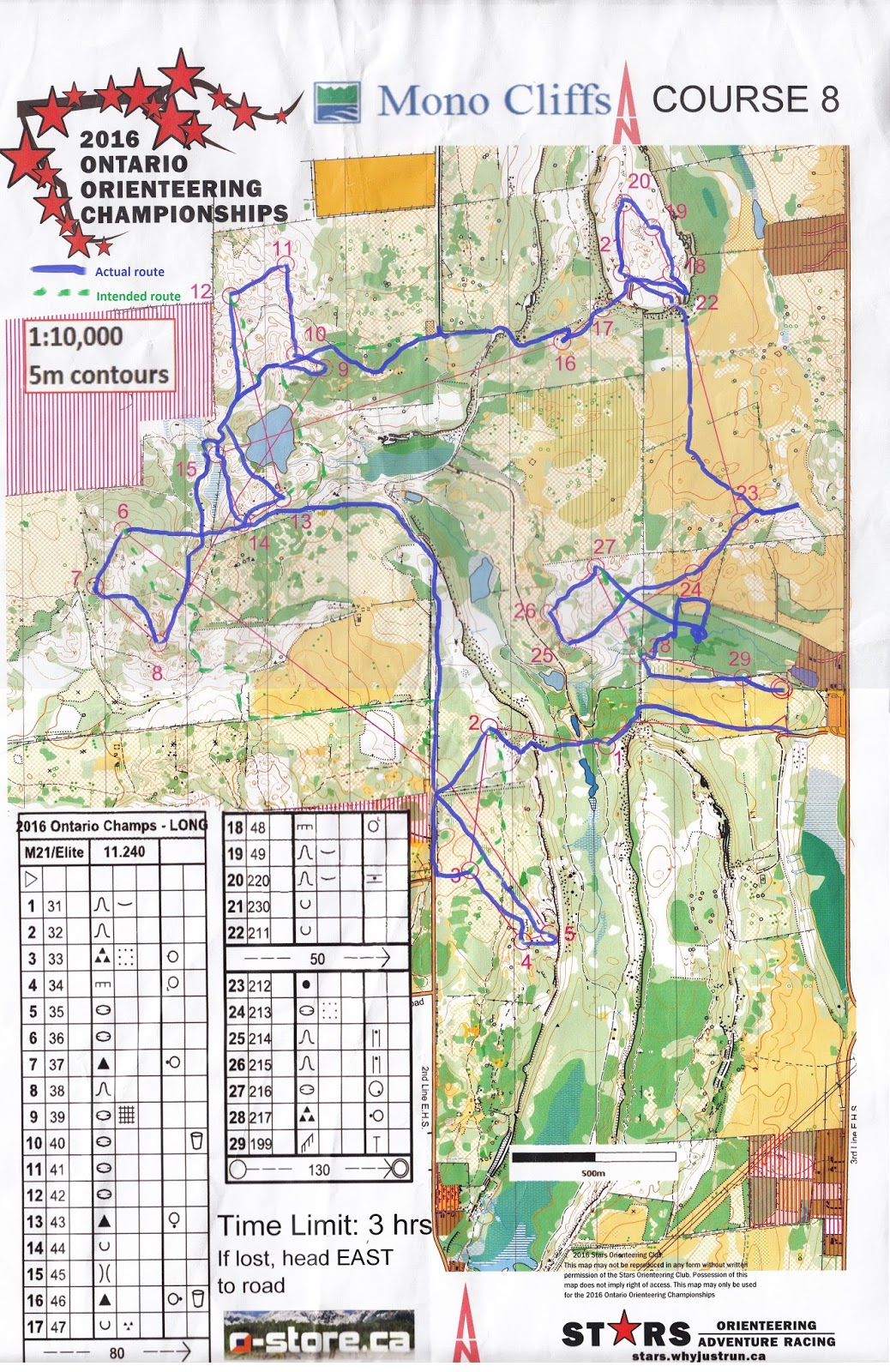
Here is the map. It was not as complicated as I thought. Still, at some local areas, there were still some navigational challenges. The course seems to have many short legs in the complicated area, and then one long leg to go to a new area.


It was a good warm-up to Control #1. When going to Control #2, a girl asked me what to do if the control punch did not beep. I told her to use the spare mechanical punch and report the faulty control after completing the course. Then, I moved on.

I feel the first big mistake when going to #6. I was thinking of taking the more direct route through the open land, but I failed to find the path that led to this open land. Thus, I just went for the less desirable plan: run through the trail, but I still needed to climb hills twice to get to #6. Not a good route choice for me.

Then, to #13, I failed to get back to the trail as early as possible, and I failed to see that the path east of the lake is a better route choice.

At #16, I started to feel tired. From that point on, I felt that I could only walk. This set up some of the biggest mistakes happened in later legs.

To #18, there were two cliffs that were so deep that there were ribbons to forbid people to pass through. The hilltop between #17 and #22 is quite an interesting area.

Then, I felt that #23 was truly my first big mistake. Even I could locate the large and shallow depression with a man-made object on the open field, I was lost when I went downhill. It took me a long time to realize that I overshot.

Later, there were a final rounds of short legs, which I thought I navigated through them well just because I walked. In fact, overall, I thought I did fine for those technical short legs. I still had a few smaller mistakes (e.g., when approaching #7, I overshot), but I did not feel fatal.

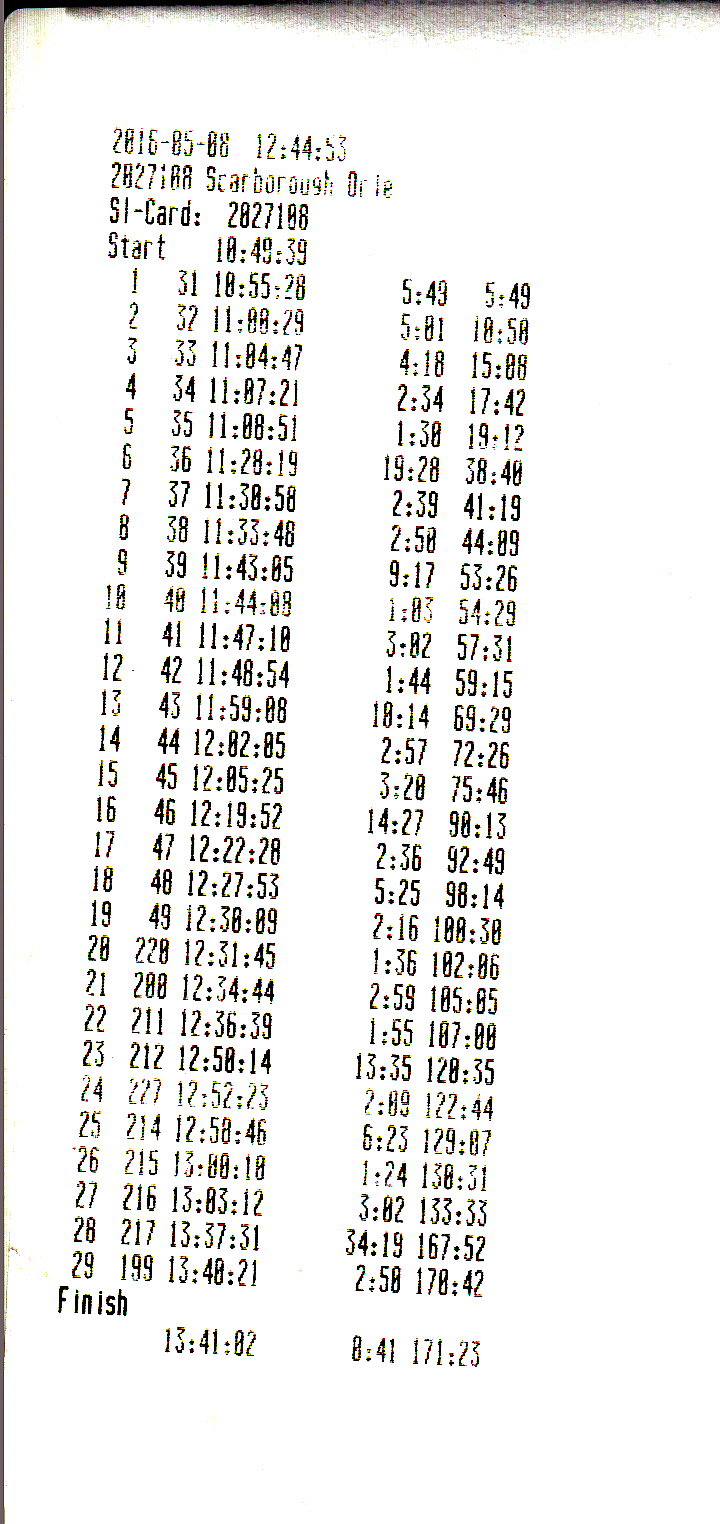
However, I could not believe that #28 took me so long to find. It was the kind of mistake that I had not made for a while: circling through an area several times, but I still could not find the control. I thought I could use the fence to guide me to the control, but later I found that I went to the wrong fence. I tried to find the right fence, but was not successful. I also tried to use the stream to guide me to the control, but it did not work, either. Finally, I just wanted to overshoot to the open area, so that I could backtrack to #28, and found it. It took me >30 min to find this, which was unacceptable in my standard. If I did this leg again, perhaps I should trust my ability to read contours?

Here is my hand drawn route:


Here is my GPS record:


I barely finished within 3 hours. I felt that I could finish this within 2 hr 15 min if I felt well.


Finally, here is the video. If I did not make such big mistakes, I should have the whole course taken.


Summary

Despite the negativity of my performance in Toronto area, I still enjoyed the orienteering courses in these three days. The maps, while not as complicated as I thought, still offer enough navigational challenges that I considered fun. I still felt that these 10 hours of long drive were worth of my time.

Monday, June 6, 2016

16-hour layover in Zurich, Switzerland

The unexpected trip

One morning, I received an email saying that I got a job interview in Hong Kong. While I was excited, I knew I might need to spend a lot of money to come back, since I had to buy tickets at the last minute, and end of May was probably considered as high season for air tickets (some students still need to travel back home after the end of an academic year). Upon the initial search online from kayak.com, I found a ticket that costs only USD 1,000 from SWISS, which looked quite inexpensive to me. However, the route included the first flight to Zurich for 8 hours, having a long layover, and then another 11 hours of flight to Hong Kong. I checked with my frequently-used travel agent in Detroit on conventional flight routes (i.e., direct flight to Hong Kong, 14 hours, by Cathay Pacific or United Airlines), and none of them were <USD 1,000. Since (A) I had never been to Europe before, (B) a connection in Europe is even cheaper, and (C) the layover is all in the daytime, I thought it would be a good idea to make a one-day trip in another continent. I know that my passport does not need a visa to visit most (if not all) countries in Europe, so this one-day trip can work out.

Thus, I confirmed the ticket. My plane left Chicago at 2:45 pm (local time), arriving at Zurich, Switzerland at 6:40 am the next day, having some fun in Zurich until the second flight that left at 10:45 pm, and arriving in Hong Kong at 4:30 pm the day after.

At the airport

When the flight descended to Zurich, it was overcast, but snow-capped mountains could still be seen. I thought: with the lakes around this area, this looks like Seattle in the U.S (or Vancouver in Canada).


After the arrival, I had to cross the immigration check. I found that people with passports from European Union have a special line for them. After half an hour of queuing, I walked through the baggage claim, with nothing to claim, since my checked baggage could go through Switzerland to Hong Kong. I only had a backpack for these 16 hours.

Public transport is across the airport. There is a travel info center, where I could buy a one-day Zurich card. It costs CHF 24 (I could pay USD 26), and it can be used to travel to Zurich downtown, and one fare zone surrounding it, without additional cost. The airport itself is one fare zone from downtown. Moreover, it could be used for museum entry, which is mostly free, while some has discounts. Sadly, I went there on Monday, when most of the museums were closed. I still used the card to travel around a lot, though.

A regional train (S-Bahn) in Zurich. The screen shows the next few stops and their estimated time of arrival.
The train only took two stops to go from the airport to downtown, which is the train station. Some of the platforms are on the ground, while others are underground. Most of the times, buying the ticket is under honor system. I did not encounter anyone checking the tickets at all. However, according to Wikitravel, the penalty is heavy if you are found that you do not have the ticket.

Swiss National Museum - closed on Monday
Uetilburg

Next to the station, there is the Swiss National Museum that I hoped to visit, but it is closed on Monday. Thus, I walked along the river to examine the city layout. Zurich is the largest city in Switzerland. Yet, the city did not look big to me. It is difficult to find buildings that have more than 10 floors. Perhaps this is how people live in Europe.

After playing with Duolingo for two years, I think I had the ability to guess the texts in Spanish and French. I did not get to German, which was what I needed here. In this trip, I could still decipher some words in German, like Bahn=train, Bahnhof= train station, and Bahnhofstrasse (the main street in Zurich) = Station Street. "Bahn" is everywhere in Zurich. On the ground level, there are many streetcars (trams) that are also called Bahn. It was a delight for me to figure out what train to take.

My first plan was to go to a hill called Uetilburg. There is a train going there, from an elevation of ~400 m in the city to ~ 800 m at the last stop. From the stop, one may continue to hike up to a hotel with an observation tower. There were also several hiking trails. One could already find a great view of Zurich city and the large Lake Zurich from the top. Farther away, the snow-capped Swiss Alps could be seen.


I went for a short hike to find a geocache. The trails nearby were pretty steep, but guardrails and chains were there to protect people from falling. It seems to me that there would be a lot of fun to hike in Switzerland!

Lunch time

On the way back, I went to a bakery to buy and try a pastry. I did not eat it until in the evening. It costs ~ CHF 3-4. When I was at the airport, I went to Starbucks to see the price of a mocha. It was almost twice the price in the U.S. Later, when I checked the prices in Burger King at the train station, the same pattern of twice the U.S. price was also observed.

I saw several grocery stores called Coop - at the airport, at the train station, and on Bahnhofstrasse. Some of them looked like a supermarket (grocery stores much smaller than Walmart). Another one looked like a to-go food court, selling only food for lunch. The one on Bahnhofstrasse is like a department store (like Macy's), selling all kinds of clothes and having a food court on the top floor. I got a lunch there, seeing that I could use the restroom there. Most of the public restrooms (WCs) need CHF coins to use, which I did not have. Just ordering half rice and half meatballs with sauce, it already cost CHF 10. Yes, the price in Zurich was like doubling the U.S. price for everything.

After lunch, I checked the price of chocolate at this Coop basement. Some of the cheaper ones were ~CHF 2-3, while those in boxes could go up to CHF 10-15. What makes them so different?

Around Lake Zurich

In the afternoon, I went to the river and took a river and lake cruise. Zurich card covered the cost. I felt that I wanted to sleep, but I could still see the river and Lake Zurich when I tried to keep my eyes open.


There were several ferry lines on Lake Zurich. The fares are like the trains, which depends on number of fare zones crossed. On the lake, I could find the familiar mallards, but there are some ducks that I had never seen, and big white birds that are probably swans.


I was tired and my brain was not functioning. I found a large building with historical architecture. Thinking it must be a museum, I went in and being asked what I was doing. After several back-and-forth responses, I found that I was actually in an office building!

Altstadt (Old Town)

I walked back to the downtown area, where a large part is the historical Altstadt (Old Town). There are several churches in this area that are worth visiting (e.g., St. Peter's, Fraumünster, and Grossmünster). They looked huge and old.

Interior of Fraumunster
Grossmunster

The clocktower of St. Peter's
I walked through the narrow streets that only allow pedestrians.


These two pictures compare the residential area and the tourist area of Altstadt

There is a cable incline train (Polybahn) that moves people to an university area.


At this point, I found that I had not seen places for charging phone battery for a long time. Before even getting to the issue that the plug in Switzerland is different from the U.S., I found that a lot of public places do not have power outlets at all. I saw the first power outlet later in the afternoon (like 3 pm). Yes, it did not matter, since I did not have an adapter. I did not see any USB charger throughout the Zurich trip. This is good to take note of if I come to Switzerland again and use the phone often.

There is also a challenge in using free Wifi outdoors. In Zurich, to use free Wifi, one needs to provide the phone number, but visitors outside Switzerland do not have one. In this trip, I only found that Starbucks has a way to get around the phone number, and only had internet access in Zurich when I was near Starbucks.

I was happy to visit one Swiss gift shop that has many creative toys. The manual music box that can be customized is one of them. I think each of these products is also an art.


I walked up the small hill of Altstadt called Lindenhof, which provides another view of Zurich. I saw several people playing chess outside.


Main station (Hauptbahnhof, HB)

This is the transportation hub of everything in Zurich. Long-distance, international trains can be found on the ground floor.


Below the ground floor, there are many underground shops. I peeked the Asian restaurants to see if there are any differences in interpreting Asian food between the U.S. and Switzerland. I was not sure. This place looked like Panda Express in the U.S., but the food served seems different to American Chinese.


One more floor below, there are many regional trains. Many goes to suburbs of Zurich, and some goes out of Zurich (e.g., S-Bahn).

Back to the airport

It was 8 pm. I should buy some chocolate before heading to the airport. When I went to the Coop department store, there was already a guard gesturing that the shop was closed. Argh! I forgot from the travel guide that Swiss people close shops early. Thus, I caught a tram back to the main station, knowing that shops there are the exception of closing at 8 pm.

It was still bright at 8 pm in summer! Zurich has a latitude close to Seattle, WA, US
After buying a few package of chocolate in a supermarket called Migros, I got on this train back to the airport.


It is interesting to find that at the airport, I went through first round of passport control and baggage scanning, walking through several terminals, and getting another passport control again. I guess this is how Switzerland deals with local and international flights in one airport.

Afterthoughts

It was rare for me to sleep at least 4-5 hours on the plane before waking up. The night I got back to Hong Kong, I had a wonderful sleep. It seems that having a day trip in Europe helps overcoming jet lag!

(This later proves untrue, since I did not sleep that well in the next few nights)

I still feel that if the air ticket that makes a stop in Europe is as expensive as a direct flight, I may consider doing such bonus trip again. Perhaps I would allow myself staying there for one more day.

Concerning Switzerland, I sense that the best of the fun would be outside Zurich. Upon some research, in about 2 hours of train from Zurich, I can get very close to the lakes and Swiss Alps.

(One of the research sources: Amazing Race, Season 3, Ep. 8 : Rheinfall, Zurich, Grindelwald)


Monday, April 18, 2016

Apr 1-3, 2016 Flying Pig Orienteering Championship XX

Flying Pig Orienteering Championship is an annual national orienteering event in Cincinnati, OH area. This year, I signed up all three races. Friday was a sprint course, which is supposed to be short and quick. For M21 (i.e., men open), Friday course was only 3.1 km. Both Saturday and Sunday courses were classic (or long). I usually signed up for a course one level lower than M21, since I felt long courses were too long for me. This year, however, I signed up M21 long courses for both days. Both of them were almost 10 km long.

On Friday, I drove almost 4 hours to the Friday sprint event. Few months ago, I learned that I can borrow GoPro headcam from the university library. Thus, I borrowed one to take video record.


Friday Sprint - Miami University - Hamilton Campus

I was in a rush when I got to the event center. I was already late, and the start was going to close soon. I did manage to put my GoPro camera and get the approval from the organizer. However, I was unfamiliar with the headcam. I pressed the button to take a picture instead of taking the video. Thus, I did not have a video record for the sprint, which is reasonably short enough for watching.

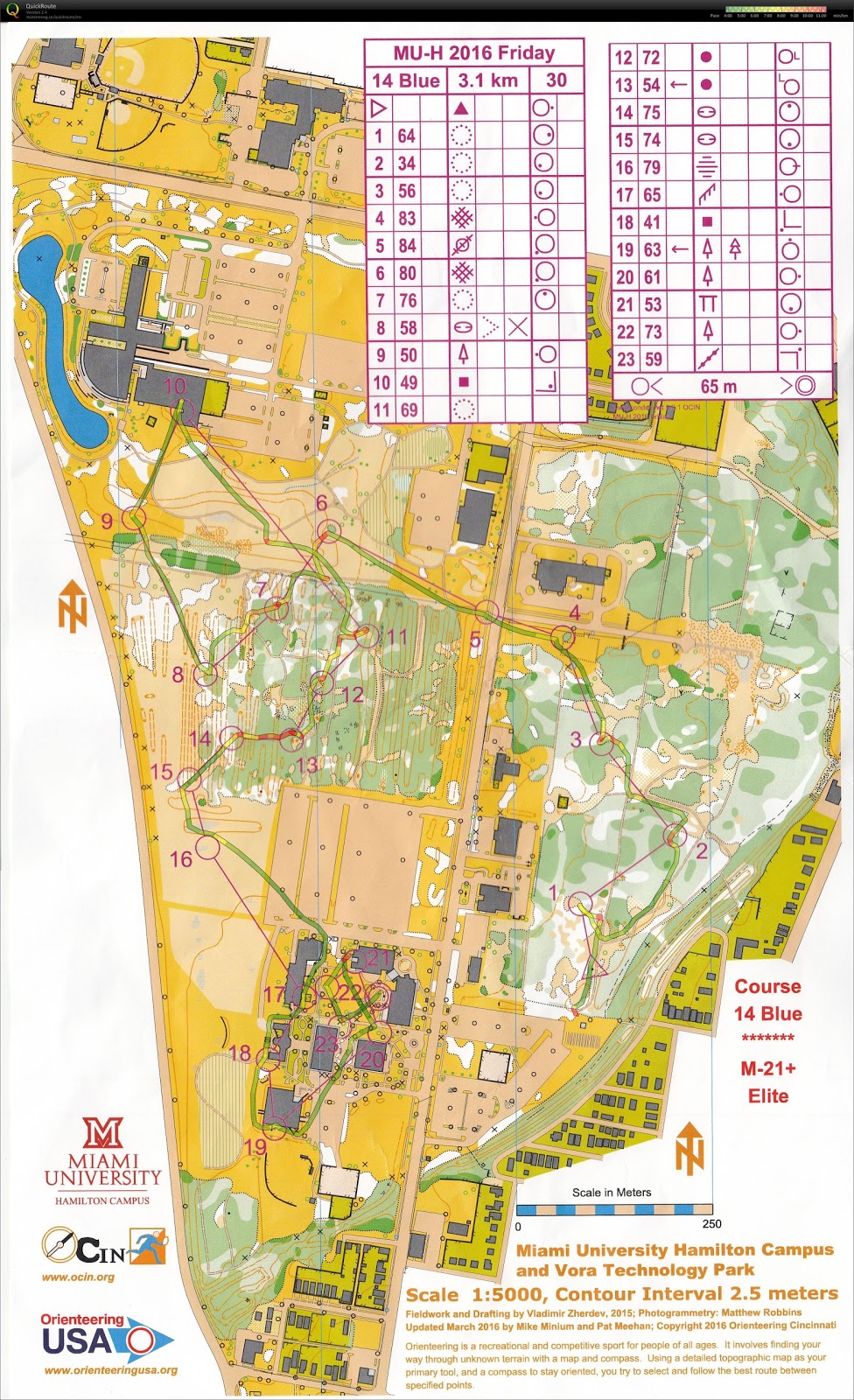
Nevertheless, I had the GPS watch record. There was not much to say about this course. Most of the navigation was easy. Controls #6-#15 were quite fun to go through, since this forested area has a lot of man-made trenches. 


Zoom-able map

I did take a video of the campus area, where the last few controls were located:


Saturday Classic - Miami Whitewater Forest, Harrison, OH

On Saturday morning on the charter bus that brought competitors to the start, I met Rob Minto from ICO. Rob has the whole family coming for orienteering, and we meet often when there is an orienteering event in Indiana. Rob told me that this was the best map in Cincinnati area. Before this competition, I found this map online to get an overall idea of the terrain. It gave me a typical feeling of re-entrant (gully) system. It is hilly, but navigation should not be difficult. Yet, Rob said, "you will see".

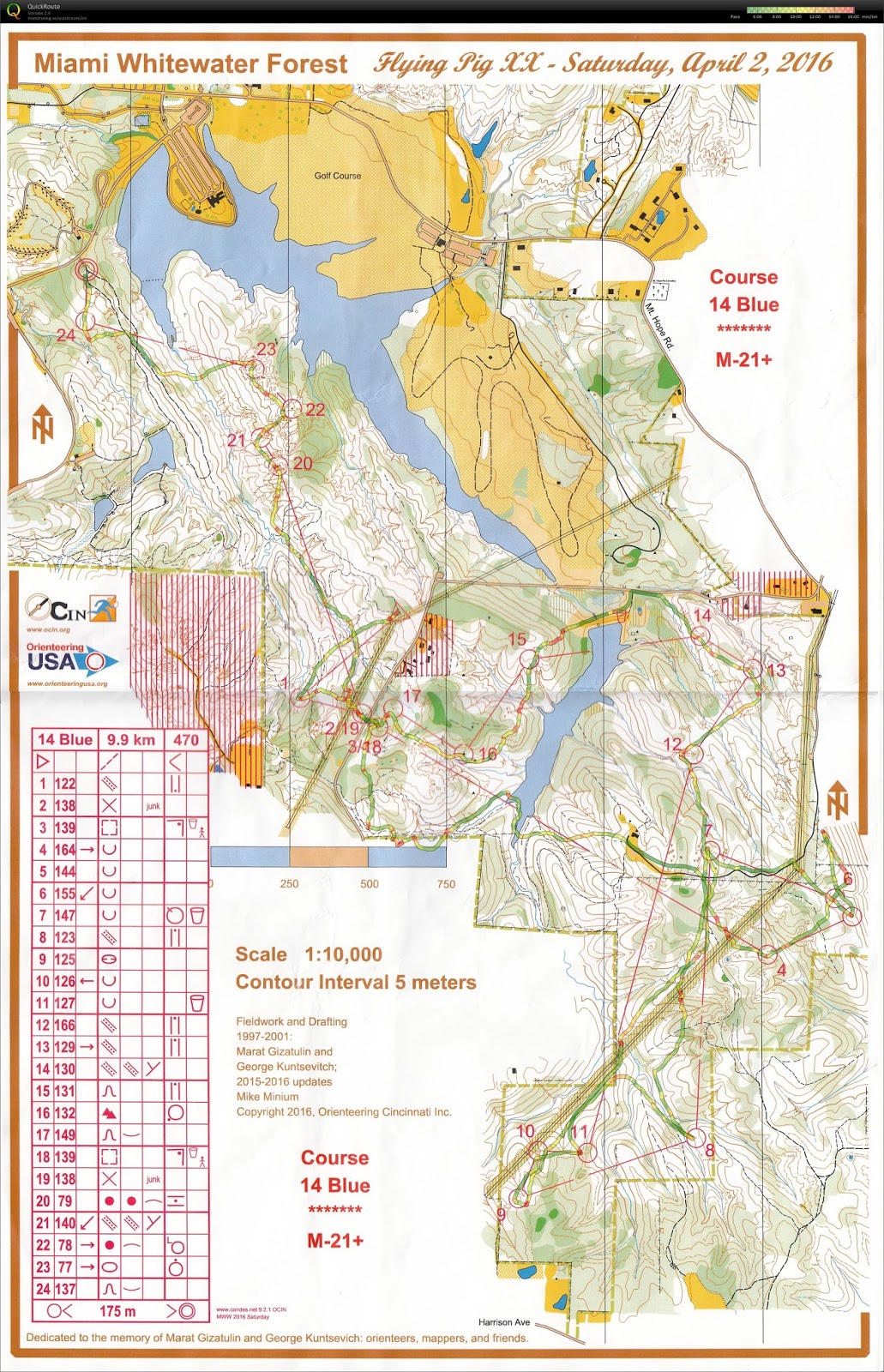
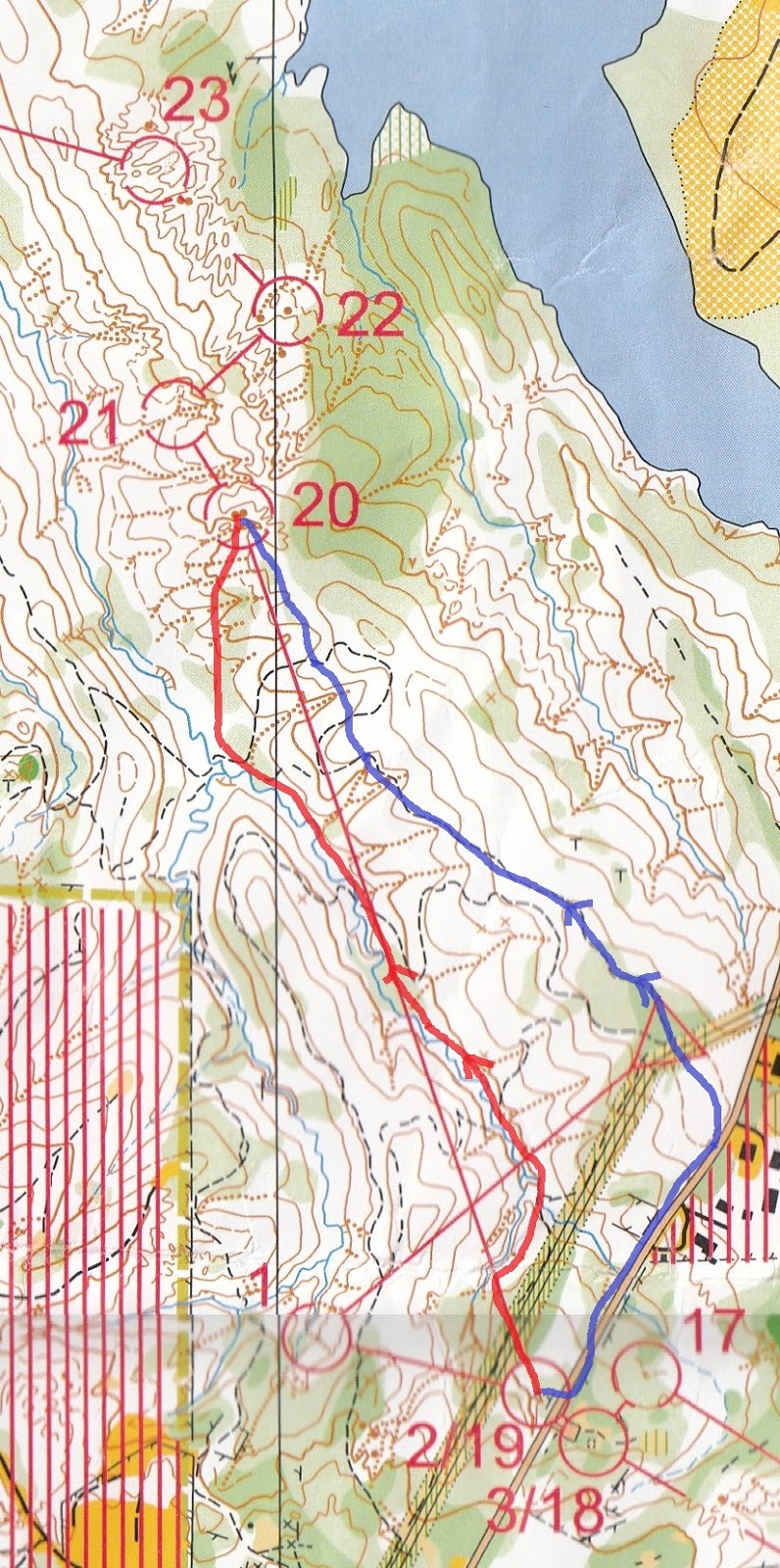
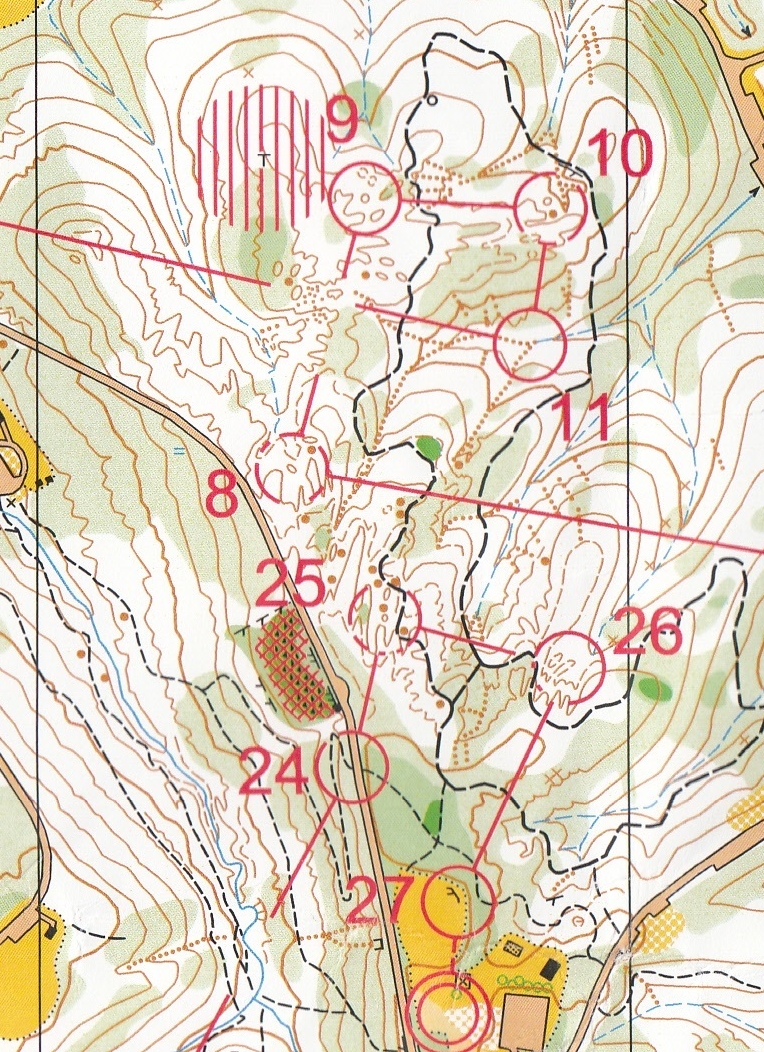
After doing the entire course, I understood what Rob meant. I was somehow elated, even though I did not win. The entire course is as follow:


Zoom-able map

I also have a video of the course. However, the battery of the headcam lasted only ~1:30:00. I only had a video up to Control #19. The video with the route can be found in this link.

Alternatively, this:


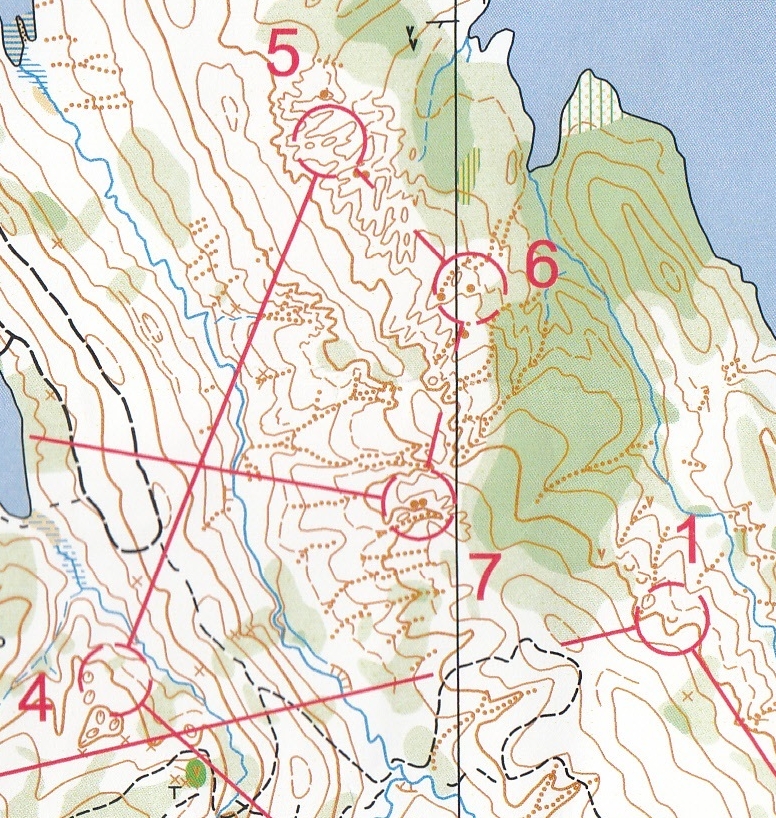
I struggled at the beginning. At the start, it took me 10-20 seconds to find the start triangle. Since there were 3 paths at the start, I could not walk until I found where I was. Then, the long leg to Control #4 , and then Control #5, were terrible. I thought I went east, but I actually went south and got out of the map. After this 90 degree mistake, I tried to take the safe route for this leg. Then, towards Control #5, I tried to aim off to the south to find the re-entrant and then went north. However, I had compass problem again. I still went too far north, hitting Control #6 first and did not realize that at first. I would even say this was a parallel error because I did hit a re-entrant, but it was the one north of what I needed to find.

After Control #5, however, I felt that I was in control of the course. Even though the decision was not perfect, I executed the route that I planned.

To Control #9, I already planned beforehand that I would rather run a more indirect route to reduce climb and reduce navigation uncertainty (red line). However, after the race, I was convinced that I could do one more climb with moderate uncertainty in navigation, while increasing the directness of the route (blue line). Some people did take the most direct route and climbed hills three times.


At Control #9, Maricel from CAOC caught up on me. He is one of the fastest orienteer in that club, and he started 16 minutes later than me. I hope I would not see him early, but I know this is difficult for me to avoid. He pointed me the location of the depression for Control #9, then he ran away. I knew my way to Control #10, since I saw Control #10 first. Then, I saw that Maricel did not run to my direction. When I went to Control #11, I saw him again. From the direction he ran, he clearly missed #10. I told him, with some reservation, "you missed the last control!" However, he did not hear me and ran away. Perhaps he knew what he was doing, so I did not yell at him any further. After all, I should probably not help if I was serious to the competition.

This course has several long legs. Besides the miserable Control #4, Control #8, #12, and #20 were also long. I tried to be safe when tackling long legs.

I thought Control #20 was fun enough (later found that using the trail east of the stream was a better choice than running along the stream), but the next three controls reminded me what Rob said. The terrain at these three controls is complicated, making me excited!


After the completion of the course, I looked forward to the competition the day after. I also checked the result, and found that Maricel did miss a control - the one that I yelled at him. Even though his time was the fastest, his result was invalid due to mis-punch.

Before leaving for the day, I bought a pair of orienteering shoes for $20. The heel of one of my orienteering shoes tore off, and it was time to find a replacement. I could not believe that I found such a cheap pair of shoes!

Sunday Classic - Miami Whitewater Forest - West

On Sunday, I thought I had a charged GoPro camera because I charged it the night before. However, before starting the Sunday course, I found the headcam was out of battery. Did it turn on by itself due to internal impact? Anyway, I did not have the video for this course. Look like I should double check the battery of the headcam next time.

More fun navigation happened today. After the run, I found out I made a lot of decision errors. I was aware of the options, but I still chose the wrong one. I also felt that this course was more on navigation than route choice.


There were still some route choice problems (e.g., Control #1, #8, and #12). I made bad choices on all three. For #8 and #12, I had thought about using roads -- longer distance but can do mindless running. However, I also thought that I would not run fast anyways. Why not taking a more direct route. After checking other people's route, I realized that I was wrong. Using roads were definitely faster.

The start was tricky. The best way to see the right route is not to run immediately, since the best choice was to leave the starting trail immediately. I was tricked at the start.

Controls #5, #6, and #7 were recycled from Saturday's course (#23-#22-#20 on Saturday)! It was still fun to revisit this area, though.


Then, there was an area with complicated terrain that we needed to visit twice: at the early half and at the end.


I did not quite know why I did not see control #16. I could not think of a better way to ensure a clean run for control #16.

In the later navigation legs, I found that I should take more direct routes to control #22 and #24.

Coming up

My friend from Toronto invited me to come to his place for an orienteering weekend. In a few weeks, I will do a sprint, a middle, and a long course around that area. Based on a sample map, there will be a lot of fun...

Sample map for Mono Cliffs near Toronto, for the long course

Monday, March 28, 2016

How my journey of dancing began

I wrote the following four years ago, intended only for my own record. Now, however, I wondered if anyone would like to know a story of being a baby dancer. When I was drawn into dancing, I was pretty amazed that I would do such activity. After all, I do not identify myself as an artistic or athletic person. Now, I still think that growing from a baby dancer to an intermediate dancer is a challenge. Most of them will just feel dancing is fun, and move on to their other parts of lives. I guess dancing just fit the needs for my life around that time! Now, I still have inertia to do it.

Thus, I copied here what I wrote four years ago almost in full. I deleted some texts that detract the main idea of this writing: how I was drawn into dancing. I knew that as I had more experience in dancing, I would somewhat forget how a beginner dancer might feel. Thus, I wrote this four years ago to make sure I had a more or less authentic record on my experience as a beginner.

So, it began from a summary of my undergrad life:
--------------------------------------------------------------
Prologue: Before there was dancing

Finally, my five years of study in the University of Michigan had ended.

Looking back, the life in the last five years went well.  I made friends from Hong Kong, U.S., and elsewhere, and we had meals together quite frequently.  There were several trips across the U.S., including trips to Toronto, Vancouver, San Francisco, New York, and even Grand Canyon and Yellowstone.  I learned how to do bowling and tried disc golf.  It was also the time that I started to go to church, even though I was not a devout Christian.  My experience in religion told me to be cautious of being intimate with a religion.  Nevertheless, church was a place where people were bonded together.  There were some people in churches that were a generation older than I am, and I was happy to talk to them.  Of course, American football in the Michigan’s Big House could not be missed!

These years I also understood what “we will always be friends” means.  Since the summer of 2002, I left Hong Kong and went to the U.S.  The stay in the U.S. started from a year of high school exchange program, and then the undergraduate study in the University of Michigan.  After that, I could only go back to Hong Kong a couple of months per year.  Before I left, there was a girl called Sophie that I contacted a lot during secondary school.  I still remembered the days when we walked to school together.  After I got into the University of Michigan, we still kept in touch frequently.

Then, in my final year in the University of Michigan, I was shocked to learn that she had a boyfriend and she typed “nevertheless, we will always be friends”.  Somehow, I also felt that I saw the same line from her in the past before.  When I asked about this matter to some church friends, I learned what “just friends” meant, and I will not forget what that meant.

This was also the time when my mom recommended me to watch a famous comedy, “When Harry Met Sally (1989)”.  One of the famous lines from that movie is Harry’s “men and women can't be friends because the sex part always gets in the way”, but Sally did not think so.  I also read a blog discussing on this line, and I learned that how men and women think differently in terms of friendship with opposite sex.  Then, I was thinking about the “just friends” matter.  Could we really be friends?  By that time my answer was “I hoped we could, but it was too hard to do in your case”. So I wished I could forget about her.

After getting admitted to the University of Illinois for my Ph.D. study that gave me enough financial support, I learned about the Hong Kong Student Association.  There was an orientation in Hong Kong before I got to Chambana, and I met new people and learned about Chambana life.  At that moment I also noticed the church group for Hong Kong students in Chambana, which allowed me to meet a lot of Hong Kong people.   At the orientation, I noticed a girl who talked about Illinois life.  She seemed to find my conversation interesting, which sparked my interested to learn about church, so she talked to me about church more. 

This opened a new page in my life at the University of Illinois and perhaps I could see more testimonies from church people after getting into this network at the orientation.  However, I could not see that after four years in Illinois.  Instead, my testimony ironically turned to dancing, especially partnered dancing.

Chapter 1: How dancing began

Welcome to the cornfield desert!  On an August day, the airport shuttle took almost 3 hours to get from Chicago to Champaign-Urbana (aka Chambana), Illinois.  Chambana can be considered as an oasis within the cornfield desert.  Between Chambana and Chicago, there is only wide open flat land and nothing else.

After working on items that were essential for living (e.g. finding an apartment), I went to the Illini Union often to watch the Olympic Games in Beijing, 2008.  The opening and closing ceremonies were spectacular. At this moment, I was thinking about how to cope with Sophie, the girl that I was interested since secondary school.  I thought I should move on.  There are always interesting people and events in life.  Friendship and relationship were still intriguing and unfathomable topics to me.

School still had not started yet, so I walked around the new campus to familiarize myself.  In that moment I thought the setting of the town was like University of Michigan.  Some chain restaurants in Michigan also appeared in Illinois.

Near the Illini Bookstore, I saw a lot of posters on salsa dancing classes.  Later, I found that these posters were everywhere, including my new office in Newmark Building, which is for Department of Civil and Environmental Engineering.  Part of these flyers said “beginner salsa… no partner is necessary and no dress code”.

Partner dancing!  That could be a fun thing to do.  I remembered the day way back in secondary school, where part of the PE lessons was to learn how to dance.  Usually, boys and girls were separated in PE classes, but dancing classes were exceptions.  In one year, the teachers showed us some partner dancing, and the entire class roared.  In the following weekly classes, we learned how to “triple step, triple step, rock step”, and how to do several moves.  I really enjoyed that class to my soul. I was thinking after these crazy dancing for several weeks.

Then after the junior year of my undergrad, I was in a month-long geological camp in Jackson, Wyoming.  While daytime was classes, nighttime was usually filled with activities.  There was one night for foosball competition, another night for talent show, and then one night there was introduction to swing dancing.  The class was fun, since the beat “step, step, rock step” came back to my mind.  At that moment, I still thought swing dancing was really fun.

Now, I was in my first year in University of Illinois (U of I), with nobody that I knew around.  After school started, I had to help out a field campaign to obtain research data in Colorado Springs.  I enjoyed the work during this month of September.  After the field campaign, however, life went slowly and I did not have much to do for the research work.  Therefore, I started to find some recreational stuff to do.  I got a Netflix account and started watching different movies.  As I watched more and more movies, I felt that I only did one-man activity and did not have any interaction with people.

This was when partner dancing came to my mind.  Partner dancing is social, plus I can meet different girls.  What a nice thing to do to ease my mind about Sophie.

It was also a time when I picked up the movie “Shall We Dance”.  I watched the American version first.  The movie gave me a first impression on how learning ballroom dancing looked like and how outsiders looked at ballroom dancing.  Later on, I was told that the original Japanese version of the movie was much better, so I watched the Japanese version as well.

Moreover, in October, I saw a dance competition at the Illini Union by chance.  It looked like dancing with music was fun.

All of these brought me to attend Dancing Illini’s classes for the first time.  I read a poster about their new session of classes, and I decided to take “Salsa and Night Club Two Step”.  This began my dance life in U of I, which was on November. I found the dance classes enjoyable and I practiced at home and in my office whenever I had time.  Each week, there were some new moves that looked challenging at first, but then I managed to execute them.  Furthermore, I thought the instructors were awesome. 

Here were some memorable lines heard in my first dance class:

·         Thank your partner and rotate.
·         Introduce yourself to each other.
·         Women in 90% of time are right.  So do not blame the follower (assume all followers are women)
·         Now you’ve learned XYZ moves.  Leads, try to mix up X, Y, and Z.  Follows, try to not expect what the lead will do next.

The last line was what I liked about partner dancing.  Such dancing was about non-verbal communications.  Signals needed to be made clear so that the followers knew what to do.  At the end of my first partner dance class, I learned this kind of signaling and reacting to the signals is called “lead-and-follow”.  I loved this, since what I liked about partner dancing in the two occasions in the past (secondary school and the camp in Wyoming) was also something about signaling.  Therefore, the concept of lead-and-follow was one of my fundamental dance philosophies.  During that class, I had many opportunities to explore the numbers of combinations of moves.

By that time, I only considered partner dancing as a hobby – something fun to do after school, and never thought of being serious to it.  The true drivers that led me to get more involved with the Dancing Illini were two events after the final session of the dance class.

The first one was graduation dance, an event after the conclusion of the Dancing Illini classes.  I was sheepish in signing up for this event, since this event brought me to the Regent Ballroom for the first time, and I was nervous on what to dress.  On the other hand, such experience might be worthwhile, and in the end, I signed up for it.

It was early December.  There were only two people in my class who signed up for the graduation dance.  However, there were many other people that I did not know. That night in the ballroom was one of the most memorable moments.  I met a female PhD student who was in the same department as mine.  She was in Dancing Illini for quite a while, and she asked me to dance to a few songs.  The problem was: I had only learned salsa and night club two-step.  In the Regent Ballroom, there was a song schedule that showed what kind of dance was next.  The dances can be the following: Waltz, Tango, Quickstep, Foxtrot, Viennese Waltz, Cha-Cha, Rumba, Samba, Swing, Polka, Salsa, Merengue, Night Club Two-Step, West Coast Swing, and Hustle.  Therefore, I thought I would sit most of the time, since I did not know most of the dances.  However, that PhD student was nice to show the basic steps for some of the dances.  I learned something like “Rumba is Cha Cha without the Chas” and “Merengue is the easiest dance because it involves just stepping with the two feet”.  The basics for swing once again brought me back the memory.

There also existed the following situation.  After I danced with this PhD student, a Dancing Illini instructor named Ron asked me “how do you think about your (dance) partner?”  I said, “Pretty good”.  He then said, “I think you mean your partner is both pretty and good!”  Nice line, Ron.

After this graduation dance, I realized that there were so many dances to learn.  This led me to taking many dance classes in Spring 2009.  At the end of this dance event, I learned the name of the PhD student to be Amanda.  Because of her kindness in showing me of the different dances, I thought I would pass on what I knew to the newer dancers when I had danced longer and learned more moves.

The second event was about one to two weeks after the graduation dance.  That was another dance event in Urbana post office building (Independent Media Center).  Once again, it was a mixture of ballroom and nightclub dances, which I did not know most of them.  There I met some of the student board members of the Dancing Illini besides the instructors.  I thought they were very nice people to hang out with.  A guy called Peter looked like a good dancer, and he looked very sociable.  There was also another attractive female fellow sitting opposite to the Dancing Illini board group, and I danced with her once, and learned that her name was Christen.  It turned out that she was one of the influential people in the Chambana dance scene.

After the 2008 Christmas in Hong Kong and coming back to Chambana, it was the beginning of my thirst for dance classes.  I started learning Cha Cha, Swing, Tango, and West Coast Swing at the same time.  I continued to meet frequently with the Dancing Illini board member.  Besides Peter, I also met Allison, Colleen, Scott, Chris, and many other awesome people that came to the classes regularly. While the classes were in the basement of the McKinley Foundation, there was some other music at the second floor of the McKinley Foundation, so we checked them out after the dance classes.  The Swing Society, another dance club at the University of Illinois, played swing music every Thursday at this place.  Since I had good impression of swing in the past, I stayed there to watch people dancing even though I did not remember much about swing moves.

Then, after the first session of Spring 2009 dance classes, I went to Swing Society for a swing class in the next session.  Meanwhile, I took more West Coast Swing class, as well as intermediate Cha Cha, Waltz, Quickstep, and Viennese Waltz.  In intermediate Cha Cha, I experienced my first class with Dancesport people, and I began to see dancing more than lead-and-follow.  It was also about techniques.  My first impression was that the class was boring, but I would try to open my mind to these techniques.  West Coast Swing continued to awe me because it has a lot of lead-and-follow, and it can be danced with contemporary music (e.g. Lady Gaga, Black Eyed Peas, etc.).  By that time, I heard for the first time that the 8-count basic of West Coast Swing, known as a whip, looked like a swingout in lindy hop.  That was my first time I heard about lindy, due to the realization of swing dancing historical lineage.

At the end of the Dancing Illini classes, there was an election for choosing the next year’s board members.  I was with my dance friends and got into the board.  I had to deal with the dance competition in October 2009.

I did not experience the classes from the two salsa groups in campus until 2009 summer.  However, those salsa classes introduced a lot of moves to me, and I felt challenged to learn them.

This was the time when I was very happy about partner dancing.  This was not only about the new moves, but also new people that I made friends with.  I also learned about the history of each group.  One story in my mind was when Yuri, who was one of the instructors in salsa group, told me about a much bigger Dancing Illini in the past, and how salsa, swing, and dancesport group broke up from Dancing Illini and formed their own groups.

There was a line that I still remembered: when I feel that I am out of moves, think if I can bring moves from the other dances, since the move in one dance may be able to be performed in another dance.  This line still applies to me today.  By doing observations about similarities of these partner dances, there seems to be universal rules that can be applied to all dances.  In the past, I thought all dances have similar hand hold for open and close positions.  All dance moves’ lead is not only through the legs, but also by the body.  Later, I found all moves should be executed as smooth as possible, even in dances with pulse (pulse is vertical, while smoothness is horizontal) or those dances with rise and falls (e.g. Waltz and Quickstep).  The dance etiquette for all of the dances seem similar.  For example, both Dancing Illini and Swing Society classes mentioned that one can turn down a dance with another person with good reason (and should not be done often), but one should not dance for the rest of that song.
--------------------------------------------
This concludes my first year's dance experience in Chambana. After reading this that was written four years ago, I still feel that I owe these people thanks for making dance scene a happy place in my first year in this place. If I were born to a dance scene at another time, I might not stay at dance scenes for this long.

Monday, March 14, 2016

A response to the shrinking salsa community

This time, I am going to write about salsa community in CU. Recently, someone posted in CU salsa Facebook Group, expressing the sad feeling about a significant shrinking of salsa community. In particular, there were too many female follows than male leads. A great number of comments followed, which I tried to read all of them. After my experiences on the rise and wane of the Illini Swing Society, I had an urge to share my opinions on these comments concerning the future of CU salsa community. I really hope that history of the Swing Society will not happen again in salsa, but from the comments of the experienced salsa dancers (presumably the leaders of the salsa community), I feel that I need to give my two cents here. In a nutshell, I think the wane of salsa did occur due to a few unfortunate events. Yet, the experienced dancers also have responsibilities.

Two dance community building approaches

Throughout my years in various dance groups, I saw two approaches of community building. These two approaches are usually along a scale, rather than a choice between these two.

Approach 1: Pay more attention on beginners

A list of activities include:
- Advertise beginner/intermediate classes to attract more newcomers to join
- Provide a beginner-friendly environment for newcomers to practice

Approach 2: Focus more on intermediate/advanced dancers

A list of activities include:
- Form private groups to train for competitions/performances
- Travel to workshops or dance events

These two approaches differ greatly. In Approach 1, the approach is like how fish reproduce to survive: you try to reach as many people as you can. Many of them, after their first session of class, will choose not to continue. Only a few will come back, and attend practice dance events. There are a lot of reasons that newcomers choose not to continue. They may feel that the footwork is too hard. They may feel that they cannot find friends to dance together. They may have other commitments, and dancing is not his/her priority. Thus, to increase number of people to stay, you need to rely on the low probability by attracting a lot of newcomers in class. It is like fish that produce thousands of eggs, with only a few survive. The leaders of the dance community can do something to increase the probability of success, which I will discuss in the next section. Still, one should accept the low probability that newcomers will stay. To give you a gist of probability, CU@Salsa in the past could have >100 people in the beginner class. Only ~20 people will continue to classes at higher level. Number of people who will then go to a bar to class is even fewer.

In Approach 2, the approach is like how humans reproduce to survive: you try to consolidate the friendship among intermediate/advanced dancers, so that they become regular dancers in a scene. Not many people will be in this group, but once they are in, they will become brothers and sisters. It does take more energy to maintain these friendship, though, like it takes years to nurture a human baby.

My recommendations for a college town

Some comments of this Facebook Group post already pointed out that dance scenes in college town has a transient nature of members: most people in the scene will not stay more than 4 years. People who stay more than 10 years are even rarer. Although Approach 2 would likely make certain people come often to a dance scene, Approach 1 is a more reliable way to maintain the dance scene with a transient nature by maintaining new blood to come in. Moreover, Approach 2 tends to create insider groups that decrease the friendliness of a dance scene.

To explain my reasons, I would try to think as if I am a person who has never danced before, but would like to test his/her interest in dancing. Literature on teaching coins a term "expert blind spot", which, in this context, means that experience dancers take certain ideas so much for granted that the beginners are actually confused. You probably have experienced that some instructors like to say this move is so easy, but nobody understands the move in the class. Hopefully I can still remember how a dance beginner is like when I am writing this.

As a newcomer lead in salsa, simply leading a spot turn or cross body lead can be challenging enough. Am I stepping correctly? At what time my arms should be at what position? This issue may amplify as these moves are lead out of a class and in an open dance. Why can I lead this in class, but not in an actual dance? Probably instructors have mentioned certain techniques to provide effective leads, but knowing how to implement takes time. With all of these in mind, I bet the beginner leads are already scared to ask someone that they do not know to dance, especially to instructors. It is already scary to dance in a practice location. Dancing at a bar like Cowboy Monkeys, Soma, or out of town, is certainly out of question.

Most beginners, especially leads, do not think of activities in Approach 2 because they are too scary to think about. "I do not want to look silly on the dance floor," they may think. What they need is a place that has reduced scariness: a floor where there are more beginners, where fellow dancers are more friendly. In the past, we had McKinley Foundation. I like this place because it serves classes and then practice afterwards. The floor is large enough, giving beginners' space to practice their floor craft, in contrast to a bar where limited floor space makes floor craft more challenging (my dance friends, who no longer do salsa, told me about that). The location is in campus area, so people who do not have a car can still attend. The early dance time (9 pm - 11 pm) is probably also great for people who still have classes on the next day. It is unfortunate that McKinley Foundation can no longer provide the floor for salsa community. I guess the next best location would probably be in the Union, although room reservation may be an issue. I may also suggest dancing outdoor during summer time, although there may be issues on dance shoes.

Another issue that I am against Approach 2 is that it may make the dance floor less friendly to beginners. I like that instructors should encourage beginners to dance with more experienced dancers. Yet, when beginners look at the intermediate/advanced dancers keep staying in their groups together, they may find scary to ask. Worse yet, some dancers that seem advanced do not like to dance with people that they do not know. When I was a baby dancer, I found that it was not worth it to ask a good dancer to dance, since I perceived that he/she would reject me. I wondered: can leaders of the salsa scene sometimes actively ask the beginners to dance? This at least shows the beginners that the salsa scene is friendly to beginners. It is much easier for beginners to leave the dance scene once they find the scene unfriendly. Although it is still okay for the leaders of the scene to mingle with the fellow dancers, can they also try to ask 1-2 beginners to dance in a night as a service? I would also suggest including dance etiquette as a part of the class. When I first joined salsa, I found this instruction lacking, in contrast to other dance groups like Dancing Illini and Swing Society.

I am not totally against Approach 2. If some experienced salsa dancers join in in a new academic year, we should ask them to join by all means. I just feel that one can only find one or two of these people in a year, and they are also likely to be transient in a college town. Approach 1 should still be the main approach to grow a salsa scene in a college town. With more beginners to join a class, you have a higher chance to grow more intermediate dancers.

What may happen when a dance scene relies too much on Approach 2? I am going to summarize what had happened in Swing Society in the last few years:

Three or four years ago, there were a lot of talented swing dancers in the swing scene. They went to workshops together and did group competitions together. However, these talented dancers tend to form their own groups. People outside the group usually do not mix in. There were also talented dancers that were intimidating to beginners. Enrollment of beginning swing class dropped. Last year, many talented dancers graduated from school and moved away from Champaign, resulting very few people who could lead the club and in the danger of shutting down. Thus, this year Swing Society focused more on building beginners and made the swing scene more friendly. The club is now still recovering, though.

Doesn't this sound like what is happening in salsa scene? One may say the departure of many advanced dancers as unfortunate, but I think we can do something to mitigate such risk, such as focusing more on Approach 1.

Community building transparency (?)

I saw another comment about a lot of dancers do not appreciate the time that leaders of the salsa scene volunteer for its growth. My reaction to this is: if I know what you can help, I would like to help. Sadly, in these years, I still feel that I cannot help salsa community, except keeping coming to salsa classes to help.

This is an issue that I am not sure why. After being in salsa community in several years, I still do not feel a sense of belonging. I do not feel that the leaders want help. I am not asked to travel to dance. I only stayed at the Monday and Wednesday salsa dances regularly, just as a habit. I think that is the only way to contribute to the salsa community -- to participate.

When I look at the Swing Society, it is different -- it is a registered student organization. It has a structure that besides president and treasurer, there is a webmaster, lesson chair, travel chair, public relation chair, and so on. They have plans to train new DJs and instructors. It seems to me that I have more ideas on how to help with the swing society. Of course, I have traveled to swing workshops, too!

Yet, why do I feel uncertain that salsa community needs help? Is that because the leaders of the scene do not say it aloud? Is that because only those who are within the intermediate/advanced group know the ins and outs? It seems to me that it is a transparency issue.

Some comments also mentioned that the current salsa community is split into several smaller groups: salsa, rueda, and kizomba, thus the community becomes fragmented. I am not too sure why they cannot be combined. After all, I am not an insider of these issues. I do think that when I stay in the rueda group, there is a better sense of community. Whether you are a beginner or an intermediate, they mingle pretty well. They even have parties together sometime, with potluck rules apply. Is it because nobody in this group looks intimidating?

I am confused now.

Thursday, March 10, 2016

Why did I swing back?


(Note: this is Part 2. Part 1, "Why did I swing away?", is here)

Viewing Swing Society From Afar

I would limit salsa discussion here so that I would say something that just relate to swing. When I was in salsa, I kept thinking how I could keep my arm relaxed while leading (which, later, was found that relaxed arms are inappropriate in salsa). I also tried to be a follower, which was learned from those people in swing society that "to be a good lead, you need to understand what follower does". I still tried to dance with various people. This was the time that I met a new salsa circle, including Felipe, Kat, Chris K., Shawn, and more. It was a peaceful time in here, given that I was on the verge of giving up dancing entirely. Some other people that left swing did tango instead, although I also saw them in salsa sometimes.

Sometime later, however, I found some people who used to do swing came to the salsa scene. Doug came in, with another girl who dressed like a swing dancer. Doug persuaded me to come back, which I held a great reservation.  Throughout the years in swing, I was persuaded several times, only to find disappointment. An example is the statement of the friendliness in the swing scene, which I disagreed. Yet, I did visit the swing scene a few times when I had time. In those visits, I mostly watched and did not dance. I still had no energy to be in this scene.

Thus, I continued to stay in salsa. At least the people are more friendly and more diverse. Later on in 2015, I knew from Facebook that Bradley was leaving. Then, when Kevin was about to leave, he held a farewell party that I only stopped by. I just went there to say hello to him, and probably to Ann L. also. I did not know anybody there. Ann L. also left in the same year. Basically, almost everyone that I knew in swing society were gone (except David and Tom). It looked like the death of swing society was near, which I felt they deserved it. Who else could succeed swing society?

The Tentative Return

Then, something ironic occurred in Summer 2015. A newcomer of salsa, Lisa, came regularly to weekly dance. I just treated newcomers like in the past -- to dance with them. She seemed to be a decent dancer when I danced with her. A month or two later, however, I heard from her asking salsa people (like Felipe) to learn swing dancing. Then, I realized that Lisa was the second swing dancer that I knew that crossed over to salsa. Moreover, she was not the student but the instructor of the swing class. Seeing that I had not been to swing for a while, and now there were friends to go to the swing scene together, I went back to the swing scene and checked out how the swing society was going. Due to several travel plans during the summer, I did not join the classes. Yet, I checked the Thursday night dances.

The swing scene did look much smaller. There were almost nobody that I knew. I might have seen Evan, but it was a faint memory. Otherwise, as I had thought, almost all good dancers were gone. A bit of willingness to ask people to dance swing returned, since I felt that those who belittled me were gone. In this place, I met another instructor, Cassie. She told me that the swing society had changed a lot during this summer, and wished that I could come back. At that time, I still felt skeptical about this statement because, as mentioned above, the advanced swing dancers tend to give persuasive but empty statements. I could not trust that I would feel the friendliness of swing community when I returned to it. Moreover, I was already in salsa community for years. Leaving them for swing seemed not to be nice to the salsa people.

Nevertheless, I felt that Cassie was a nice person, and I knew that she is a great dancer. Sadly, she was about to leave Champaign soon. Her story in swing society and why she would leave soon actually touched me. No doubt that she was a great swing dancer because she used to be a practice partner with Bradley. However, Bradley left Champaign for Chicago, and there was another reason that I was not comfortable to say it here. As a result, she moved to Virginia to further her swing dancing.

To test whether I should come back or not, I asked Lisa if I could DJ a section of Thursday dance. She immediately agreed, which I greatly appreciated it. The only comment in my mind was that how you could trust my DJing ability. You did not even know the song list that I had! I might have played something that was not appropriate in the swing community! Yet, I began to feel that I could forgive the swing society of the past. My strength to dance swing returned. I could not believe that it was the salsa community that brought me back to swing.

On the last swing dance in Champaign for Cassie, she still hoped that I could still stay in swing society, although she understood if I chose not to stay. Thus, her request lingered me for a while. I had been hurt by swing society in the past. Yet, now the swing society was clearly dying. I might have felt cold about the death of this club, but I began to forgive the club now. In fact, I saw a hope that swing society could be friendlier in the future. There was still a little hope that the club could survive.

I found that I would like to talk to Lisa more. At a short road trip to Monticello for a live band dance, I realized that swing and salsa were not the only dances she did. She basically danced everything, and knew many of the dance locations that I knew. That was very interesting. She said she had worked in Champaign for 8 years, and that was my dance age. How come I did not see her before somewhere on the dancefloor? She also mentioned her ice skating ability, which I was like "Wow!". I had not met a person who danced everything for a long time, and I could guess that she is much more gifted in dancing than me!

I usually had reservations to ask a girl to be friends because I felt that if she has a boyfriend, I should not get too close to her (this may be another topic in the future). For Lisa, however, I felt an urge to say that "I wish we can be good friends". Perhaps it was just infatuation kicking in, so I told myself not to get too excited by it. Nevertheless, I felt that she was one of the most important dance people that I had met.

Her presence was, however, just slightly longer than Cassie. She got a dance instructor job for ballroom in Tennessee, and would move out before the Fall semester began. There was a farewell of her, where, interestingly, swing and salsa people met. She asked me to keep dancing, which was what I was doing throughout these years. The question was more like which dance I should stay at. I missed her, but I understood that she would have fun to be a great ballroom dancer. I hoped I would see her again in the future, perhaps in some other dance events. It turned out that I did, once, when I planned a trip to the south to visit several friends.

Finding a Better Reason to Stay

Thus, almost all great swing dancers were gone. My energy to swing seemed to be rejuvenated. Yet, I needed to have a better reason to come back to help with swing. The reason cannot simply be personal, since experience told me that personal reason would not last long to keep me to contribute. I still had doubts to come back when I got to kickoff dance, and even the first class. Yet, my mission statement slowly formed: to provide newcomers more opportunities to see the depth of swing dancing, while keeping the swing scene friendly. At Lisa's farewell, I met the swing group that includes Evan, David, Tom, and a person that I had never met: Yvonne. It turned out that three of them were the instructors of Fall 2015. After the kickoff dance, I felt that the swing society board was easier to work with. I truly felt that they were nice people. Yvonne is as nice as Tom.

I began to DJ a lot. Leah replaced Lisa to be the lesson chair, and Leah was also a nice person to work with. It seemed to me that there was a shortage of DJs, since Leah asked me to DJ quite often. I hoped that sometime later, we could train new DJs. Later in the year, Yvonne asked me to be the travel chair, which I forgot why. This became my first time to get involved in the swing society. While I still felt that I was not very good in swing dancing, I felt that there were a lot of technical transfer to do, so that the next generation of U of I swing dancers has most of the philosophy of a swing community.

I heard more stories that filled my void on what had happened in swing society in the last few years. The stories seemed unpleasant to me. I suspected that the great dancers scared the beginners away. These stories reinforced my mission to make swing society a friendlier community. I hoped that the gap between the great dancers (only a few left) and the beginners can be closer.

Yet, I still hoped that my swing technique could be improved. I started to re-watch some workshop videos in the past, and hoped to find time to practice. My other commitments (like finishing the dissertation) did tell me to lower my expectation a bit. As long as the swing scene becomes more welcoming, I am happy with it.

Tuesday, March 1, 2016

Out-of-town dancing report - A swing workshop weekend in Dayton, OH (Feb 26-28, 2016)

(Disclaimer: this is a report that I try to be honest with my feeling. I will still say something that I feel great about this dancing trip, but such description will be balanced by something that I feel sad about the trip.)


Last weekend, I broke my words years ago about "never more workshops" by signing up to Dayton Swing Smackdown. Seeing that there were a good number of fellows from Champaign going (6! We need two cars), and knowing that Cassie was going (the reason will be explained in another blog), I decided to think this trip as a re-evaluation of experience in going to a swing workshop.

My energy was high on Friday night. It was a live band night. I could still recognize a few faces besides Cassie. These faces were known from some workshops long time ago. I was excited to show Cassie the new UIUC folks that came to this workshop event. Several of them, including Leah D., has not met Cassie before (there were several Leahs in the workshop, and Leah D. was not the one that she has met). They may see her as an advanced dancer too intimidated to approach. Thus, I need to introduce them to her.

Similarly, Leah D., the current lesson chair, was excited to introduce her dancing friends to us. She also arranged housing for our whole group. The host was very nice, too!


The quality of workshop is excellent, as usual. I especially like the second session, where Danny and Mandy talked about swingout in Charleston style. I also got to dance with another instructor, Shannon, twice. I did feel the connection difference when dancing with advanced people.


Also, we would not forget the line dancing and the birthday dance with a T-Rex:


Now, here are my emotional struggles about going to workshops. You may stop reading if you only want to feel positive about an event.

(This line is intentionally left blank)


1) The dancing ability plateau

One of the goals of going to the workshop (no matter how small the importance I think) was to know my current dance level. By doing the level test and amateur competition, I knew the reality. It seemed to me that I still had not put hard work on this dance. Egoistic feeling of not wanting to lose resurfaced, causing more frustration with dancing.

Then, I thought about Adrian, who came back to UIUC Swing Society last year and sat for the full dance for the whole semester. I knew him for a long time that he was good at swing and won competition before, but he seemed to lose interest to dance. He said something like it was good for me to be fun to beginner dancers, and he could not provide such fun.

When I returned to swing, I promised myself for improvement. Yet, after months of dancing, it looked like I still stayed at where I stopped. Conversely, I had a fear that serious practicing caused me to become one of those good dancers who are serious about them. My goal in this Swing Society is to keep beginners interested to learn more about swing and feel loved in this society, not to make another clique of advanced dancers, right?

2) Friendliness is within elites

In this workshop, I still saw these that brought me to the past shadows: I saw people who wished to dance with more advanced people, so that they can go to advanced lesson track. I saw people practicing on their own posture in a social dance event. I met advanced dancers who seemed defensive with dancing with lower-level people.

There are nothing wrong, it is okay to choose dancing to be serious. I just choose to not push my dancing that far. After all, my career is not about artistic expression. I still love my maps and reading about environmental issues, and they will be possible career path that I aim for. Dancing is fun, but if I cannot fulfill my basic needs, I should pause my dancing.

Thus, I generally do not feel close to elite dancers. Yet, I cannot identify myself as a genuine beginner. I start to feel the group classes provided by the Swing Society no longer provide new information. Yet, I do think that there are a lot of things that I do not know, so I am not towards the next level of dancing yet.

Thus, I am not in the circle of elite dancers, but I may start to scare true beginners also by what I am doing. I am in the middle of the ravine between the beginner rim and the advanced rim, by myself.

I also noticed that while many people were dancing, some of us just sat most of the time and checked the phones. Perhaps they were tired or scared to ask strangers that are great to dance with...

3) The recurring doubt that whether I like dancing or not

Do I really like dancing? Compared to these people who travel to every major swing dance events and form their own jazz bands, I feel like I am not. Compared to my office mates, however, they would think I am too crazy in dancing. Somebody even asked me to write a dissertation on dancing. I can now safely tell them: there are some people in the world who dance everything, except they are much better than me (this will be described in another blog also). At least, I will not put dancing as my career.

Yeah. I still have a love-hate relationship with swing.

---------------------
These reasons are insufficient for me to stop swing dancing now. The above points do cause me to maintain my cautious feeling on workshops.