(Note: this is Part 1, and my first time to post something about dancing. There will likely be Part 0, but I will not write about it until I have more time. Part 2, which titled "Why did I swing back?", is here. All of this concerns with vintage swing, which will likely be a section of a greater essay "A Testimony of Dancing" that is about how I get into dancing in general, all the partner dances that I have tried, and events that cause me to keep dancing till now.)
The Golden Age of Swing Society
Dancesport was a place where I realized that competitive dancing is a not a good fit for me. Before joining dancesport, I considered dancing to be a relaxing activity after a day or work. Dancing is also considered a social event, which is better than staying at home and watching movies from Netflix. After my experience in dancesport, I went into a crisis that puts dancing into stressful hard work than fun. Preserving the fun of dancing was one of the reasons that I no longer danced ballroom competitively.
Thus, I started to spend more time in swing and salsa, where the heavy lead-and-follow concepts made me like such dances more. I also started to learn Argentine Tango to substitute ballroom, but I already digress.
This was the end of 2011. I saw a change of swing society. There were dancers that focused techniques much more than in the past. This was the time that I like Bradley's class. However, I called this the beginning of Aaron and Andrea era. They not only taught the classes and brought new dancers to workshops, but also grew several talented new dancers. This was the time when Anthony, Raine, and later Kevin came in.
In 2012, it was the time that I followed this group of people to travel to workshops: Pirate Swing in Ann Arbor and Hawkeyes in Iowa City. I knew about Heartland in Des Moines. I met new instructors in St. Louis, Christian and Jenny. I recognized more names of famous instructors and swing bands at this time. I also realized that swing weekend workshops, while costing significantly ($50-$150), were still cheaper than salsa workshops ($100-$200) and tango ($200-$400). Moreover, swing people have the culture of hosting. Many times, those who attend workshops out of town will have a place to stay for free, instead of staying in a hotel that costs more money.
I saw Anthony and Raine were so into swing and practiced together, and Kevin later joined. They placed or even won competitions in workshops, and of course placed in advance tracks of workshop classes.
This was also the time that I learned DJ-ing in swing society from Anthony. I started to collect music and checked with Anthony. Later in the year, we even shared the cost of albums from Jonathan Stout. I appreciated swing jazz during this time period.
The downside of the Golden Age
However, I was concerned that swing society would become another dancesport, where dancing becomes too serious. The more I danced, the more I found that swing could be more challenging than salsa. If one wants to dance freely with the correct style, a lot of directed practices needs to be made. This brought me back to the differentiation between recreational and competitive dancing: I felt that with a PhD to finish, competitive dancing is not a right time for me. In particular, I began to realize that being relaxed is a centerpiece of success in swing. This seemed to be against what I was learned in ballroom and salsa. I was confused on how to fix my arm lead and tense arms, fearing that relaxed arms become "spaghetti" arms. To focus on this problem, I even stopped dancing salsa and danced only swing to immerse more on swing philosophy.
I also did not feel friendly in this swing society. In fact, before this era, I also felt that the club was not as friendly as the other dance clubs. At this time, however, the instructors stressed that swing culture was friendly. I still did not feel it, and was confirmed with some other dance friends. There were moments that I felt embarrassed when they reacted to my poorly chosen music in a mocking way, and when I stumbled in a certain movement. I tried not to think about it, since I agreed deep in my mind that swing is more fun than salsa because of more degrees of freedom, thus the lead-and-follow skills become more important. Still, I felt that perhaps swing dance scene is friendly, if you are at an elite level.
A recurring question for me in dancing, even now, is that "how can I preserve my mind as a beginner?", which can be a question in other forms like "how can I be humble to dancing?" or "how can I be nice to new dancers?" In dancing, it appears to me that experienced dancers and beginner dancers are separated by a ravine: for a beginner to get across the ravine to become an experienced dancer, a lot of pain needs to get through. The pain can be discouragement, feeling of lack of improvements, or isolation. Experienced dancers look intimidating, and I am afraid that you will reject me the dance. I wonder if this ravine can be narrower if we can get into the mentality of beginners (especially the leads, who have a lot more to learn than the follows, and who may feel shy just because most of the leads are guys).
How I faded out
With more sadness in dancing and the large expenses for workshops, I decided to not going to anymore workshops after the Nevermore Swing Festival in St Louis (I found the word Nevermore quite ironic to me). I lacked interest in dancing, but I still tried to ask opportunity for DJ-ing, since I still wanted to contribute to the club. At this point, DJ-ing was my only lifeline with the Swing Society. I felt that I would quit the club at any time, but I really did not want to. This was also the time when Ann L. and Lou came in.
Then, in the summer of 2013, I found that I was not invited for DJ-ing. I had nothing to do with the club. I felt lack of interest to improve. Thus, I cut off all contacts with swing, and went solely for salsa instead. I was often told that I danced like salsa, but I did not fully know the philosophy of salsa. Why don't I stay in salsa to learn more about the philosophy, while also thinking about how to fix the tense arm problem? I did feel angry at that time. It seemed me that the swing society did everything they could to make me leave. I also thought that if this club continues to create a wide ravine between the elites and non-elites, new people will be intimidated to help. When these elites are gone, the club will die. I would keep an eye on the future prospect of this club.
It was sad, but I had to let go of swing to find fun in partner dancing.
Extended reading
When Lindy Hop Isn't Fun Anymore
http://rebeccabrightly.com/lindy-hop-fun-anymore/
(Continue to Part 2)
Monday, February 15, 2016

Sunday, April 12, 2015
Mar 27-29, 2015: Flying Pig XIX Orienteering Championship, Carter Caves State Resort Park, KY
On March 27-29, I was with an undergrad, Alex to attend the
Flying Pig Orienteering Championship XIX in eastern Kentucky. This year’s
Flying Pig overlapped with spring break, so we can participate the full event. I tried to register as many the same courses as Alex, so that we could compare our results. It turned out that we could compare the sprint and middle courses. On March 26 (Thu), we drove 6 hours to Carter Caves State Resort Park, KY.
 |
| The Lodge, the event center where the internet was served |
On our first night, we went to the Lodge in this state park,
which was the event center where we could pick up the competition package. This
includes:
race bib:

model maps:
 |
| Carter Caves Model Map |
 |
| Morehead State Model Map |
…and course lengths:

We then camped there for three nights. It was so fortunate that we chose the coldest days to camp. On these nights, temperature dropped as low as 14F (-10C). This was weird given that the temperature last week was around 50F (10C). In the next morning (Friday), I took a picture of our campsite:

I also had some time to walk around the area, visiting some practice controls.
 |
| Control #66 on practice map |
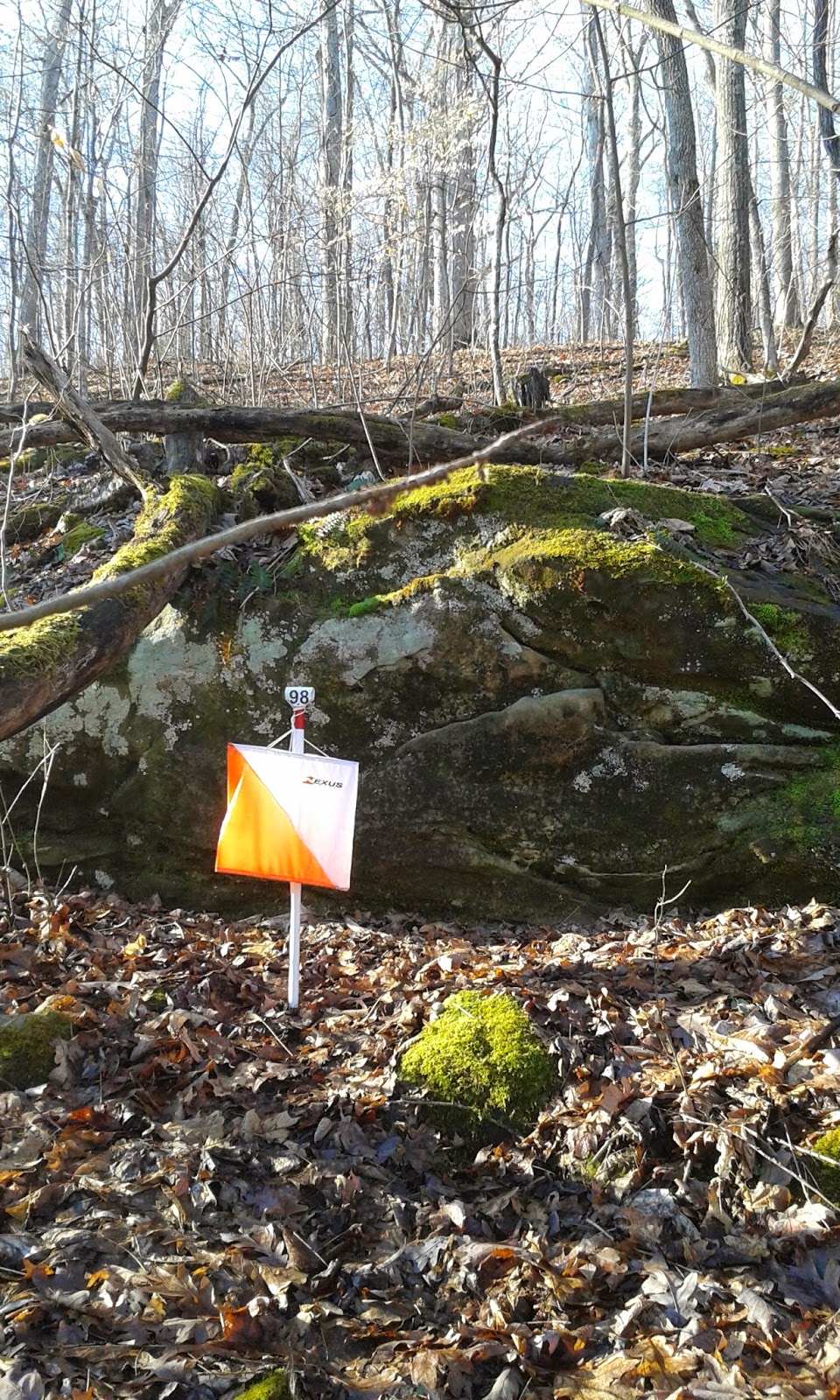 |
| Control #98 on practice map |
Friday Sprint
The sprint occurred in the afternoon at a small community college. I was assigned to start at 4:06 pm, which was not too early or too late.

I ran around a bit in the model map area because it was quite cold. A few flurries were dropping. This picture was taken at the furthest west of the model map area.

This was my time to report to the start. Once entering this area, there were still 3 minutes to wait. The start was behind the corner of the building.

Here is the map:

...and here is my hand drawn route:

...and the result:

This sprint was quite long. Typically, I thought an official sprint race is between 2-3 km. Since, I was not that competitive, more distance was more fun for me.
The trickiest was probably #10-11, where you needed to read the impassable wall. I took the bait...
#13-14 was also quite tricky. I did not see the stairs to go down at first.
#15 was easy, but I read the wrong control number on the map, so I thought I was at the wrong place, but actually I was right.
#21-22: I used a less obvious way to run. I thought the way that I chose had less climb. Even though it might be longer, I could save some energy.
The following pictures were taken after the sprint:
Finish line:

Start line:

This was my control #26. This one made me hesitate a bit because I would like to find out whether it was on the second or first floor.

A control near my #5, which was on the other side of the road.
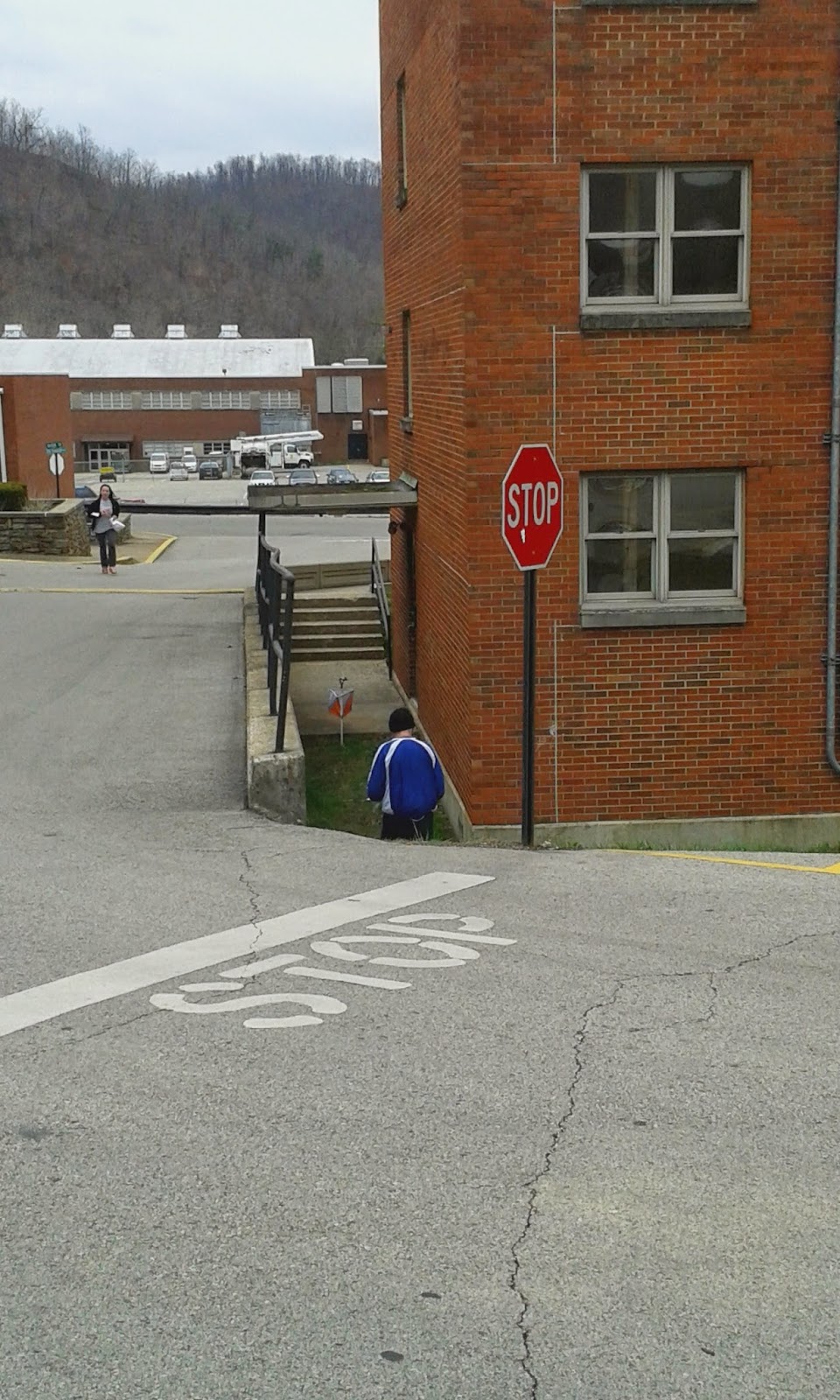
My control #2

Alex was a bit sad. He made a serious mistake towards the end. Still, comparing other controls, he was still slightly slower than me. He told me that he did not like sprint that much because there was no time to read map and no room for mistakes. Well, let's hope you will feel better when doing the next two courses in the next two days. They are longer.
When we got back to the Lodge of the Carter Caves State Park, it was snowing!

Saturday Long
I woke up from the tent, and walked to the start. The starts for long and middle courses were just few steps away.

Right outside my tent, somebody set up a fun course outside. In this fun course, you were given a map that only instructed you where to turn or not, and where to punch a control. The bearings in this map made no sense in this course. It was possible to punch a control multiple times, and ran on the same loop several times. From what I heard from Alex, if one made a mistake, the participant would likely need to restart.

You may look at the maps on the right, which shows how the instructions could be given.

.jpg)
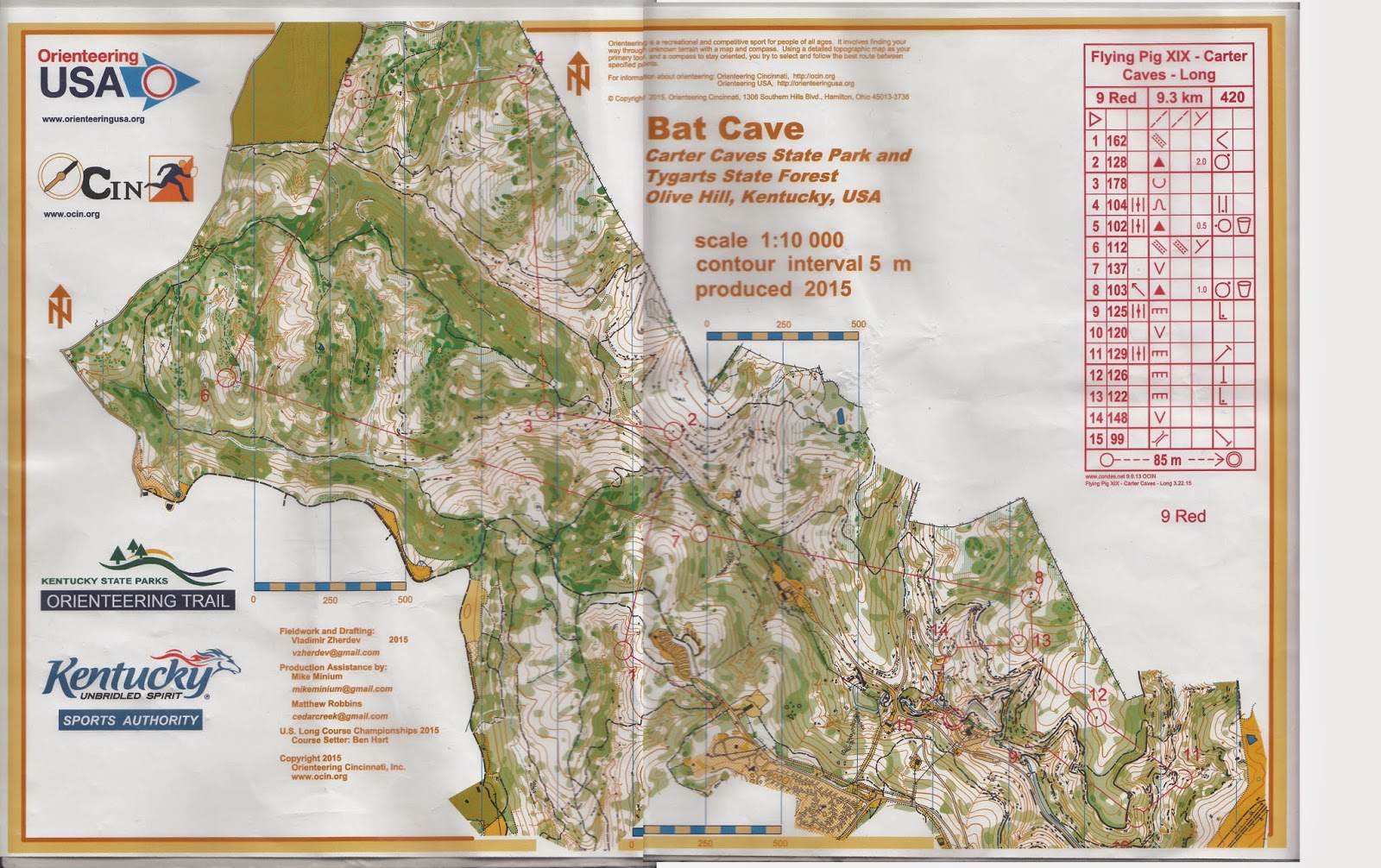
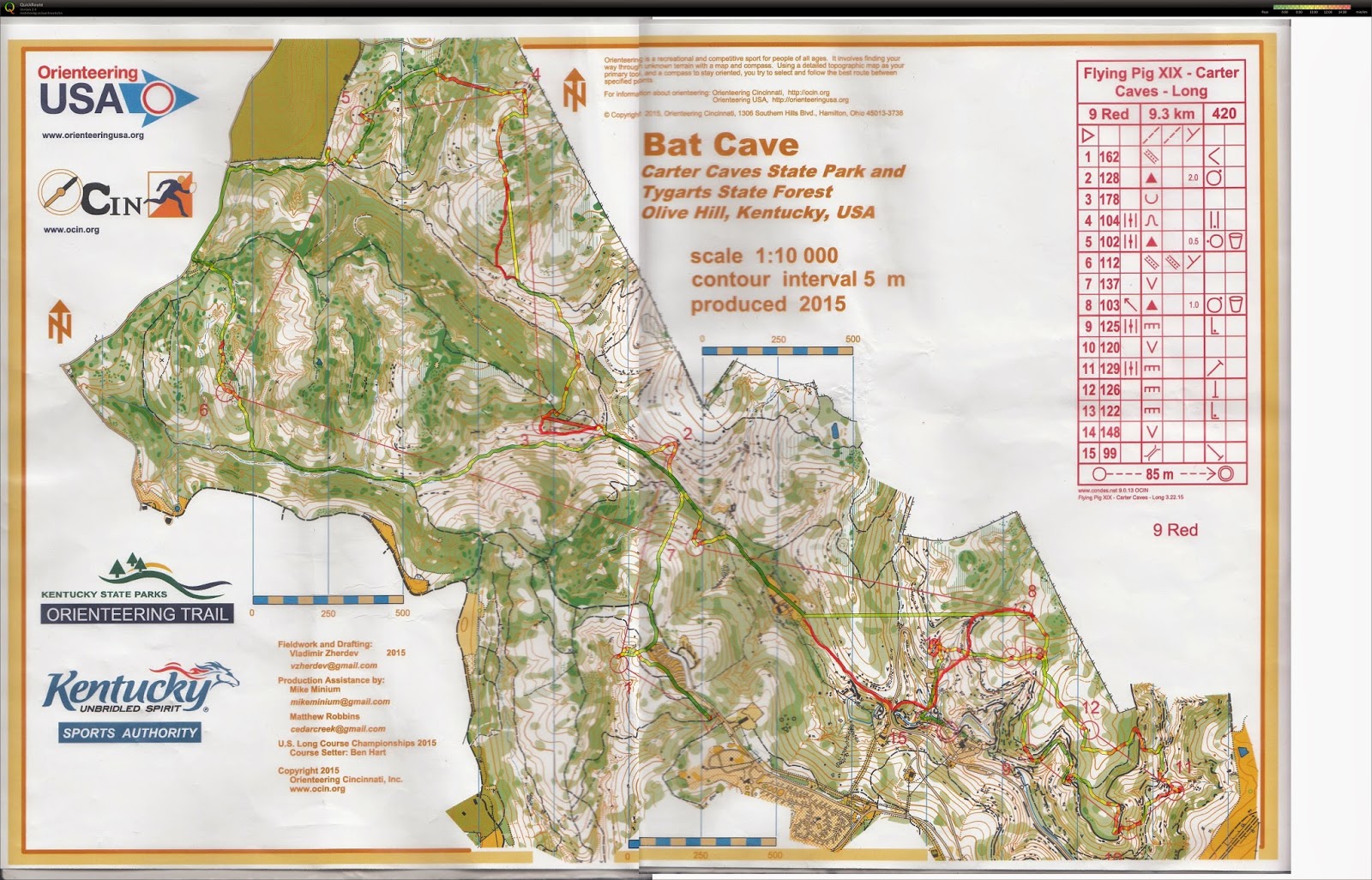
This is my GPS data combined with my hand drawn lines that described my route when my GPS was off.
%2Bmod.jpg)
and my time:
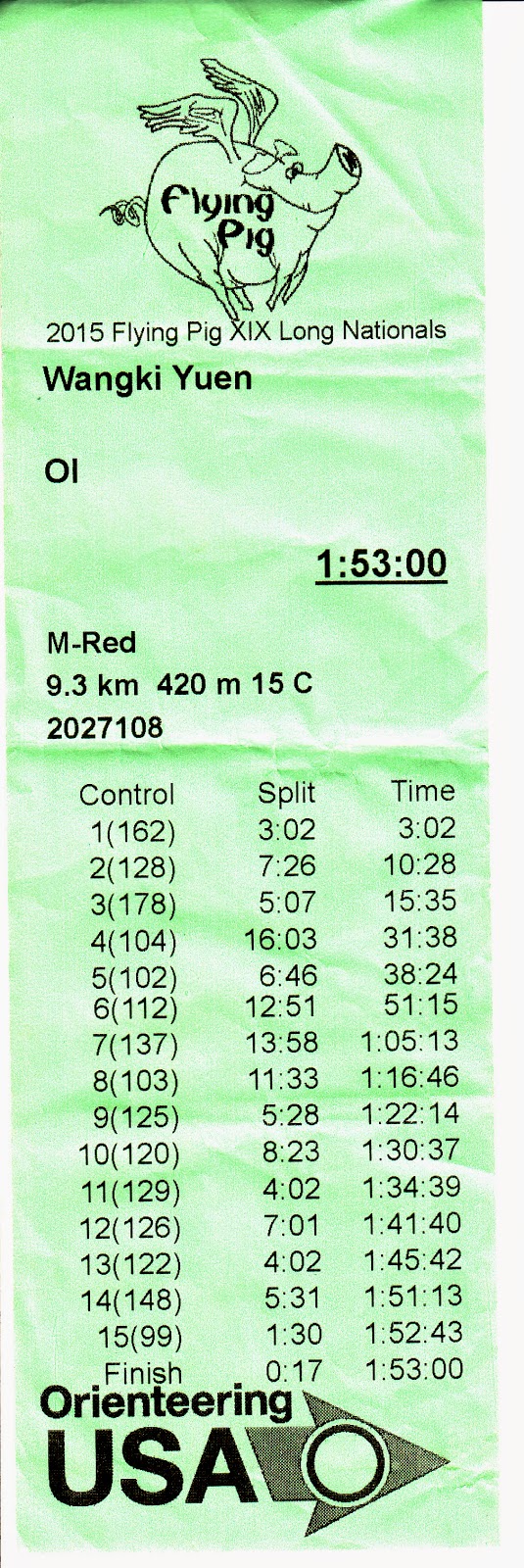%2Bresult.jpg)
The course contained long legs in the first half, and middle-distance legs in the second half (I know that long legs will actually cover more than half of distance, but I classified the halves based on the nature of legs).
My routes to the first 4 controls were not the most optimal. In control #1, I overshot slightly to upper part of re-entrant. I guess I could get there 0:30 earlier without this mistake. In control #2, I did not need to go to the open area and went straight north to find the road. I also overshot a bit when I got close to #2. This was likely a 0:30 error. In control #3, I estimated a 1:00 error because I strayed off the trail too early to approach #3. In control #4, I thought of running to the next stream, heading north to the second stream branch, and going east to get to the control. However, I decided to use a more direct route with more climb. I made a wrong choice. When comparing to other people's results who use the stream route, they were about 1:00 faster than me.
Then, I felt I did fine in the following legs. In control #10, I went too far north, so it took me some time to find a little spot that I could drop down from the cliff. Look like I should simply use the route below the cliff. I thought the route might be slow because it was steep, but those who chose the below-the-cliff route was faster than me.

In control #14, I was baffled by the other control next to the rock. I kept seeing that other control, but I did not see mine. Where is my pit? This control just took me a while to carefully locate.

At the finish:

At the finish line, the organizer tried to put countries flags that represent the nationalities of all participants. I did know later that one flag was missing. Why? I will explain below.

A few hours later, when the organizer was packing, I asked the organizer if I could walk back to the long course area to take some pictures. He said yes, so I went back to my control #14 to take a picture, the control that gave me trouble.

For the rest of the afternoon, I walked around other areas in the park. First, let's look at this part of the map, which was near the finish:
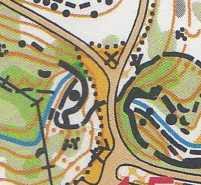


Next, let's look at an excerpt of the practice map area. Notice the thick black oval that represents the cliff:

At the actual location, it looks like this:

This picture shows the thick black oval:

This picture was taken from inside the cave:

In the evening, Alex and I went to the dinner with the orienteers from Chicago. After we got back to the Carter Caves, David gave me a medal. I really did not expect I would get this!

What was going on was that there were only 3 people registered as M-Red. I was the fastest among three, so I got a gold medal. Hurray!
When checking the results in the red course, I noticed a Japanese name that was at the first place. Since getting an overall first place in such event is not easy, I checked if he was famous in orienteering. He is! His name is Hiroyuki Kato, who was at first place in AsOC 2010 sprint. Perhaps I should check with him on Sunday.
Sunday Middle
On the last day, I packed my tent first. Then, I still had hours to wait for the start for the middle-distance. I was assigned almost the last person to start.
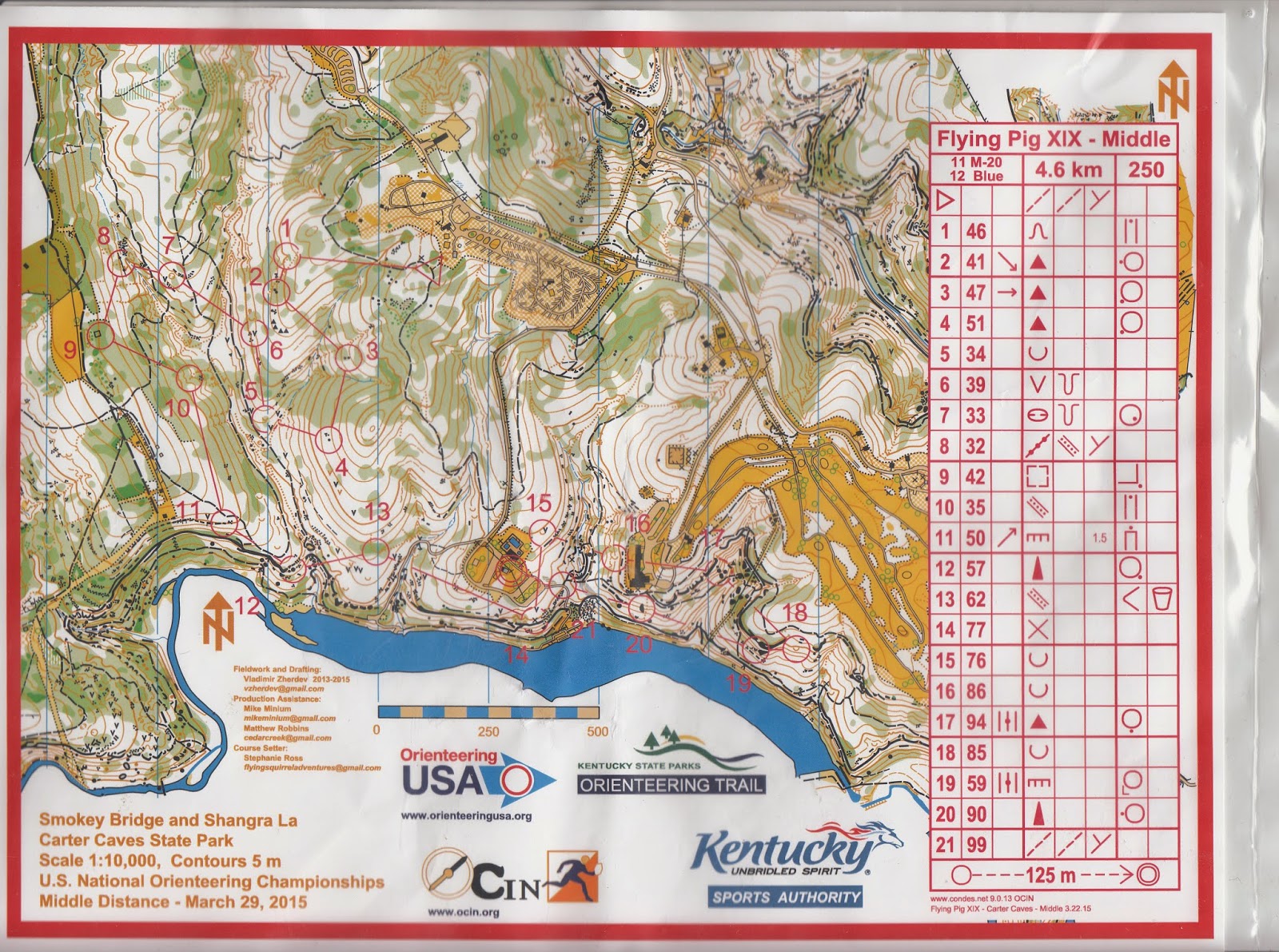
Here is the map for middle-distance:
On the last day, I packed my tent first. Then, I still had hours to wait for the start for the middle-distance. I was assigned almost the last person to start.
Here is the map for middle-distance:
.jpg)
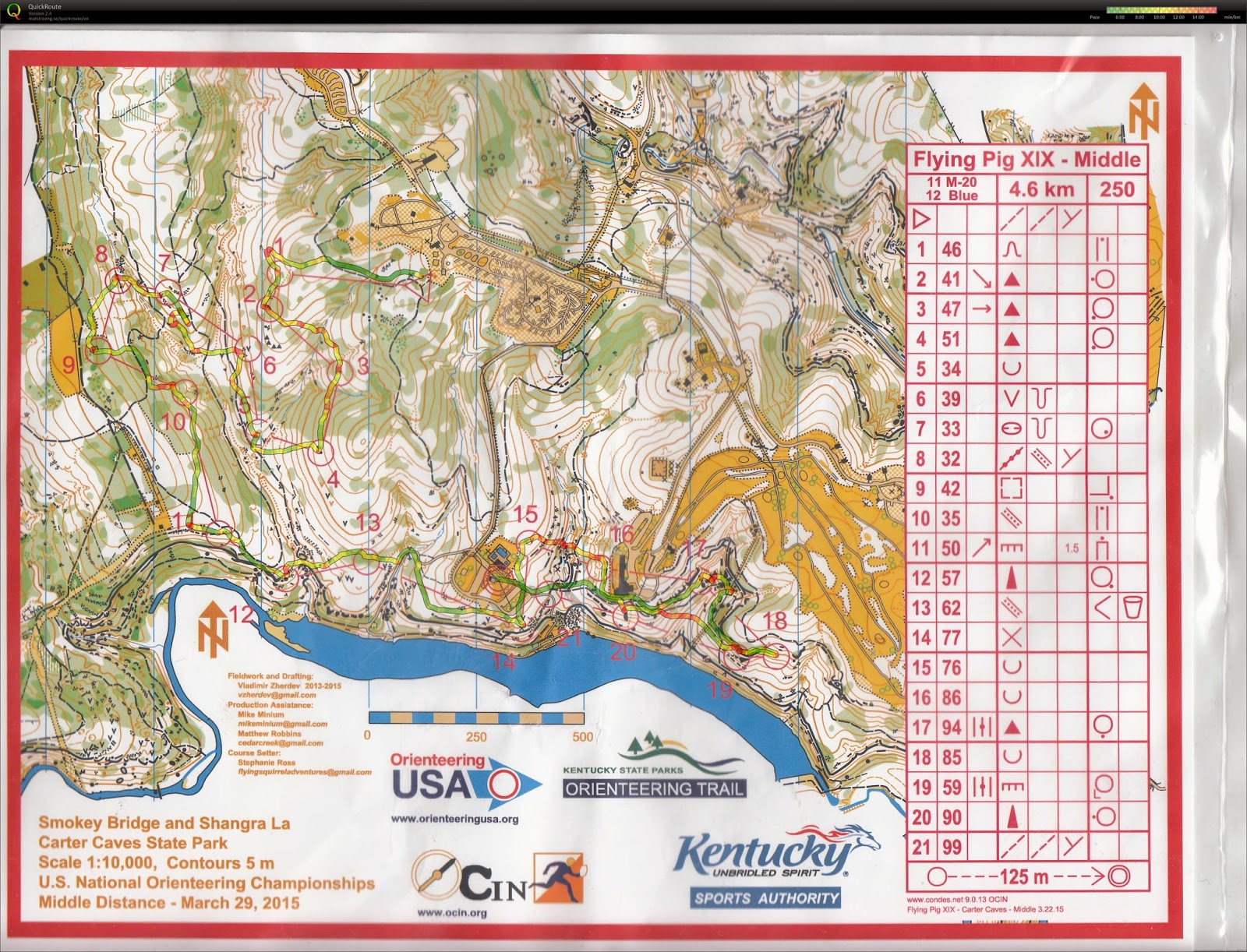
My GPS data:
.jpg)
My splits:
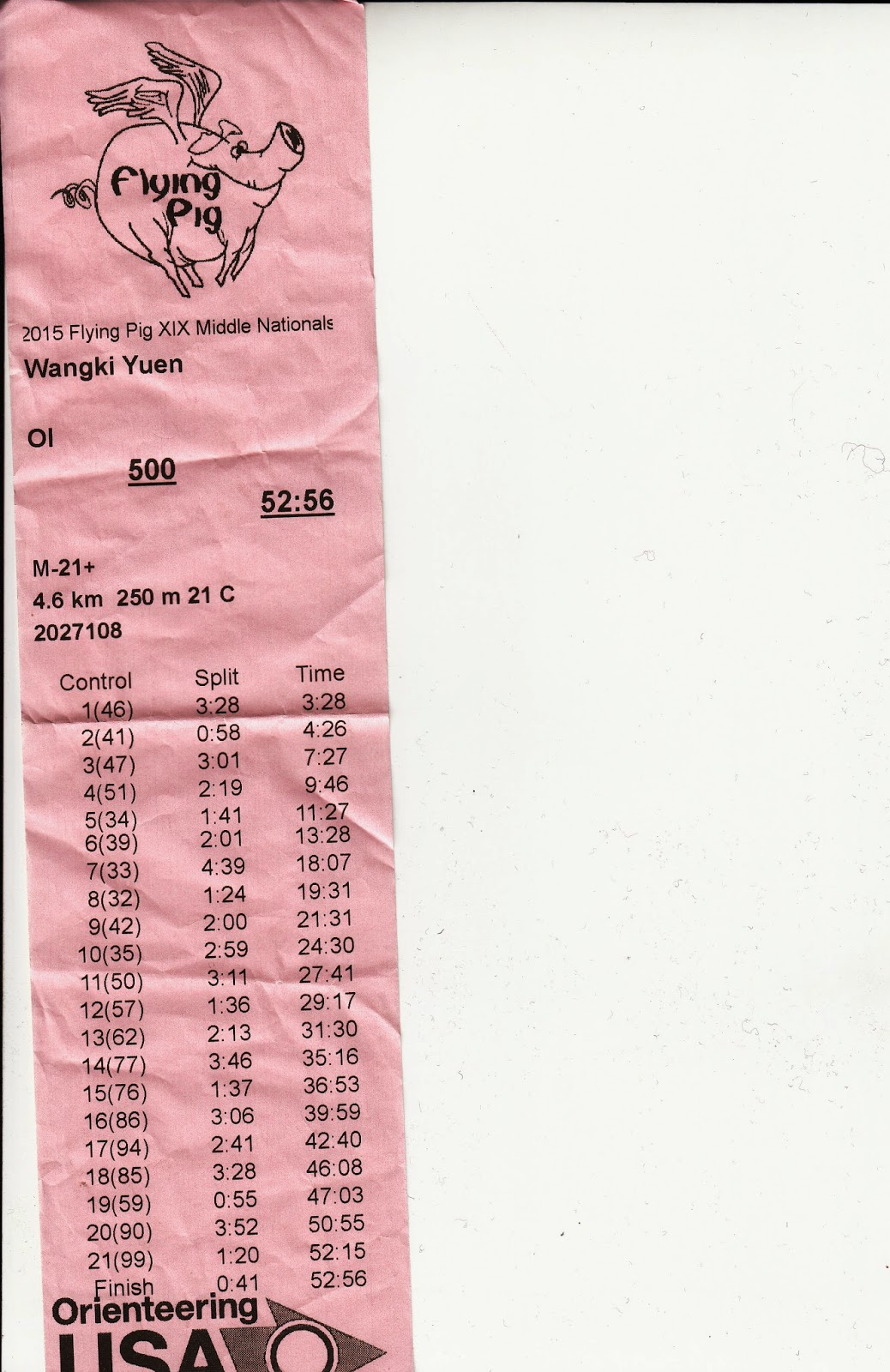%2Bresult.jpg)
Alex almost beat me for this course. He did better than me in the first 14 controls. I knew that my run was not that smooth in the beginning.
At the finish, I did find Hiroyuki. We talked a bit and he did know some of the Hong Kong orienteering competitors. We took a picture together.

The finish line looked similar to the long course. A Japanese flag was missing!

Now, let me show you this excerpt of the middle map. Do you see the grey area? That is the tunnel where competitors can pass through. The path on the grey area is above the tunnel.

Control #16 (see map above):

This is the tunnel:

Control #21 (last control, see above map)

Below are other views of the tunnel:


Acknowledgements
Thank you for the SORF funding provided by UIUC to financially support our participation of this competition. We gain valuable experience in competing against top orienteers in the world.
Subscribe to:
Posts (Atom)